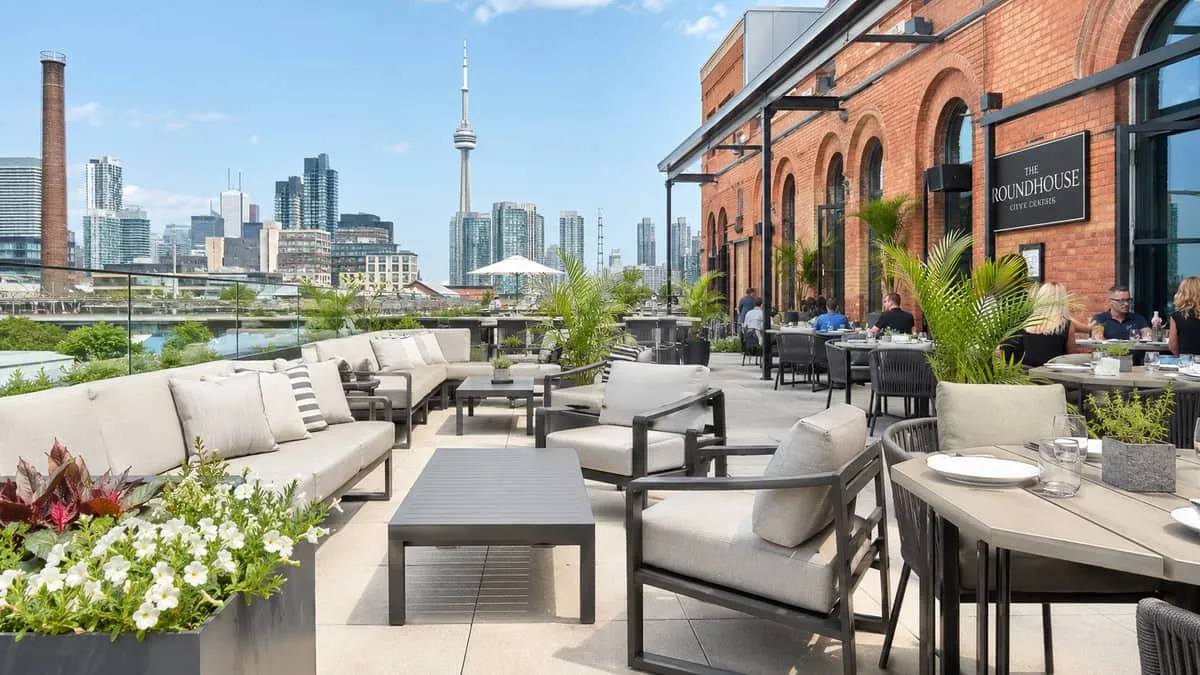
Toronto treats its patio season the way other cities treat their indoor dining rooms: seriously, aggressively, and at scale. From April long weekend through Thanksgiving, the city's licensed patios on King West, along the Harbourfront, and through the Distillery District courtyard system operate as the primary revenue-generating surface for hundreds of hospitality businesses. The furniture sitting on those patios is not a decorative afterthought. It is a licensed, inspected, weather-exposed piece of commercial infrastructure that has to perform across a five- to six-month season and then come back ready to do it again the following spring.
This is what commercial patio furniture Toronto operators need to understand before they spec, buy, or replace their outdoor seating.
Toronto's Patio Licensing Reality and How Furniture Fits In
Toronto's boulevard cafe and patio licensing system is administered through the city's Municipal Licensing and Standards division, and the requirements touch furniture directly. Licensed sidewalk patios in corridors like King Street West, Queen West, and College Street are subject to clear zone regulations, barrier specifications, and setback rules that dictate not just where furniture can go, but what configurations are physically possible.
What this means in practice: your furniture selection and your floor plan have to be designed together. A bistro table with a 24-inch top fits inside a narrow King West licensed zone where a 30-inch round does not. Stackable chairs that can be cleared quickly at closing time matter when your licensed patio has to be fully packed away nightly under your permit conditions. Operators who buy furniture without mapping it against their actual licensed footprint often find out at inspection that their plan does not work.
The city also evaluates the structural integrity of barriers and furniture anchoring in some licensing contexts. If your patio spec includes umbrellas or overhead structures, base weights and frame engineering become part of the conversation. For operators going through initial licensing or renewals on Entertainment District rooftop patios, these details are not optional.
King West and Queen West Sidewalk Patios: The High-Velocity Case
The licensed sidewalk patio strips running along King Street West between Bathurst and Spadina represent some of the highest-volume outdoor hospitality real estate in Canada. On a Thursday or Friday evening in July, these patios are cycling tables every sixty to ninety minutes. The furniture takes serious physical use: chairs being dragged across concrete, tables shifted for group configurations, servers navigating tight quarters at speed.
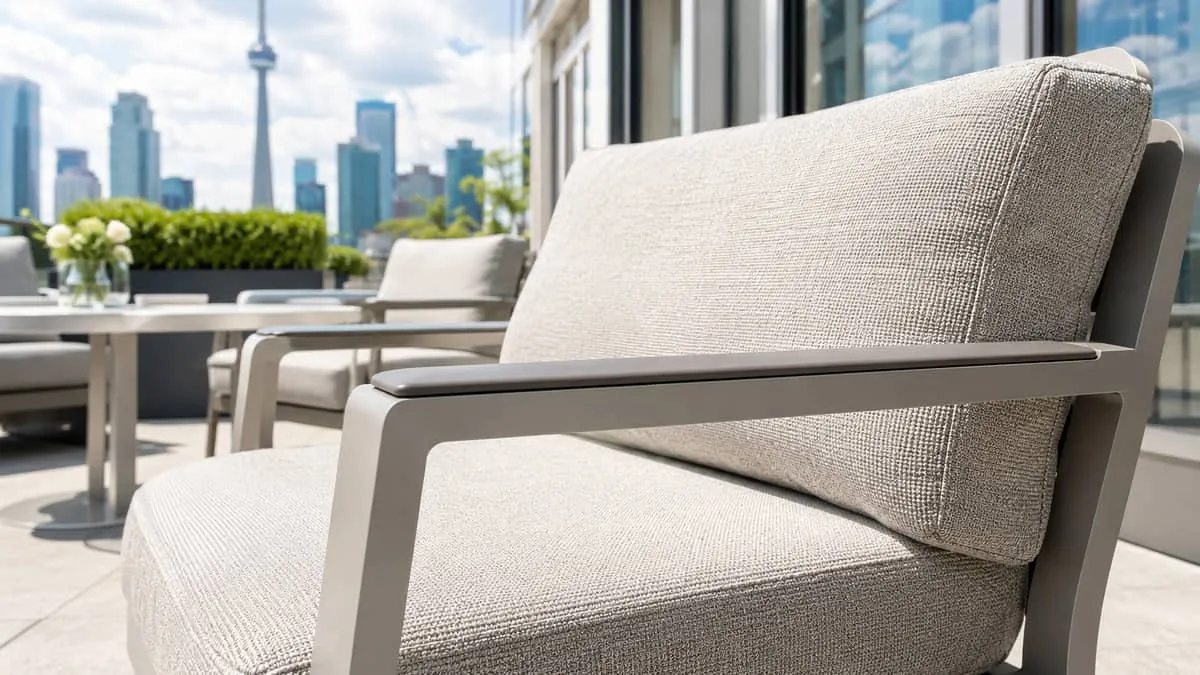
The correct spec for this environment prioritizes durability and simplicity over aesthetic complexity. Powder-coated aluminum stackable side chairs are the standard for good reason. They are light enough for staff to reposition quickly, stack to a manageable footprint at closing, and the frame will not corrode or deform through years of King West seasons. The powder coat finish should be applied over a proper primer system and rated for exterior commercial use, not the lighter coatings found on residential outdoor furniture from big box retailers.
Tables in this context are almost always aluminum or steel commercial tops with a folding mechanism or a base that nests. Cushions are a management decision as much as a design one: if you have floor staff with the bandwidth to manage pulling cushions for rain and replacing them, they elevate the look. If you are running a fast-casual operation with a lean team, fixed cushions on a King West patio become a liability. The operators doing this well on King West tend to run a clean aluminum chair in a single on-brand color with no cushion, or a very simple seat pad that is easily swapped.
Brand coherence matters here because these patios are visible at street level to thousands of pedestrians daily during peak season. Soho House on Adelaide and the cluster of hotel bars along Wellington have raised the design standard in the Entertainment District generally, and neighboring operators feel that pressure.
Harbourfront and Waterfront Restaurants: Volume, Weather, and the Tourist Variable
Patio operations along the Harbourfront, from the restaurant row near the Westin Harbour Castle through to the Waterfront BIA's Queen's Quay corridor, face a different set of conditions than the inland entertainment strips. Lake Ontario's exposure means more direct wind, higher humidity at the furniture surface level, and UV exposure from both sun and water reflection. The tourist-facing nature of Harbourfront dining also means higher table turnover during summer peaks and a guest mix that is less brand-loyal than a neighborhood regular crowd.
Furniture spec for waterfront commercial patios should weight corrosion resistance more heavily than it would for an inland location. Marine-grade aluminum with a minimum 0.080-inch wall thickness on frame members is worth specifying explicitly when you are sourcing. Welds should be reviewed on samples before committing to a large order. Furniture that handles a Lake Simcoe dock context will handle Harbourfront conditions; furniture rated for general outdoor use may not.
Wicker or synthetic rattan construction is used extensively in Harbourfront restaurants, particularly for lounge-style seating on restaurant patios with a waterfront view component. The key distinction for commercial buyers is the difference between all-weather synthetic resin wicker woven over an aluminum frame versus wicker over a steel frame. Steel-framed synthetic rattan will rust at the weld points and the frame feet within two to three seasons of waterfront exposure. Aluminum-framed construction adds a meaningful cost difference upfront and eliminates a recurring replacement cycle.
Tabletops in waterfront settings warrant attention. Teak tabletops age well with waterfront exposure and develop a silver patina that reads as intentional rather than worn. HPL (high-pressure laminate) tops on powder-coated aluminum bases are the volume option, practical for high-turnover breakfast and lunch service, and easy to source in commercial quantities. Tempered glass tops look excellent on a Harbourfront terrace and perform well, but require management protocols around wind events.
Distillery District Courtyards: Heritage Context, Mixed Flow, and the Cobblestone Problem
The Distillery District presents a genuinely specific brief for furniture buyers. The nineteenth-century industrial architecture, Victorian brick buildings, and the cobblestone street and courtyard surfaces create an environment where furniture aesthetics and furniture physics both matter. Tables on cobblestone surfaces wobble unless the base design accounts for uneven ground, which means adjustable leveling glides are a practical requirement rather than a nice-to-have spec item.
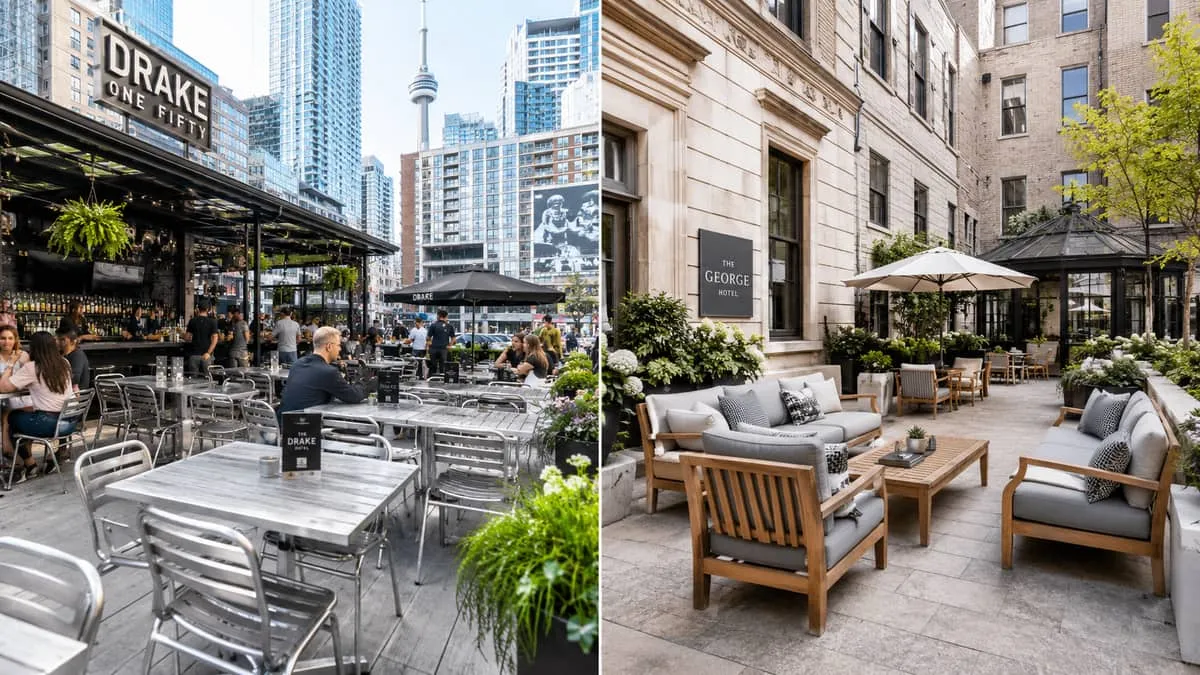
The Distillery's tenant mix, which includes the Boiler House, El Catrin, and a cluster of boutique hotel and event venue operations, skews toward a guest who is on a destination visit rather than a neighborhood walk-in. That guest profile supports a higher furniture investment. Teak seating with substantial frames, stone or concrete-look porcelain tabletops, and considered upholstery in weather-rated fabrics are all appropriate for this context and the expected guest experience.
The mixed indoor-outdoor flow at many Distillery venues means furniture often moves between spaces seasonally or for events. Weight and ease of handling factor into this calculation. A teak armchair that weighs 35 pounds is appropriate for a fixed terrace position; it becomes a problem if staff are expected to move it in and out of a heritage building multiple times per week. Lighter aluminum pieces in heritage-compatible finishes, bronze or aged pewter powder coats for example, are a practical middle path that reads appropriately in the district without creating an operational burden.
Heritage aesthetic does not require reproduction furniture. The better-specified patios in the Distillery use clean contemporary frames with warm metal finishes and natural material tops, which sit alongside the Victorian brick without competing with it and age gracefully through the outdoor season.
Rooftop Patios on Entertainment District and Yorkville Hotels: Design Expectations at Elevation
The rooftop patio segment in Toronto has expanded significantly with the growth of boutique hotel development along King West and the renovation cycle in Yorkville. The Ace Hotel rooftop, the Thompson Hotel's patio, and elevated terraces at Yorkville-area luxury properties including the Four Seasons represent a category where furniture investment is highest and design expectations are explicit.
At this level, furniture is photographed. It appears in the property's own marketing, in media coverage during TIFF and major conventions, and in the continuous social media output of guests. The visual durability of a furniture choice matters as much as its physical durability. Pieces that read as premium in a photo are different from pieces that merely hold up to weather, and the best commercial patio furniture for rooftop hotel applications satisfies both criteria.
Weather performance at elevation adds variables that ground-level patios do not face. Wind loading on umbrellas and overhead structures is greater. Temperature swing between a sun-exposed rooftop in July afternoon and the same surface on a cool spring evening is more pronounced. And the logistics of getting furniture to a rooftop, by elevator or freight lift, mean that piece dimensions and weights need to be evaluated before ordering rather than after delivery.
Lounge-configuration furniture, low seating with generous proportions, wide armchairs with deep cushions, daybeds, and low occasional tables, is the dominant format for Yorkville and Entertainment District rooftop terraces that position themselves as destination bar experiences. Sunbrella or equivalent solution-dyed acrylic fabric in performance colors is non-negotiable for cushion upholstery at this price point, both for appearance longevity and for the practical reality that rooftop cushions are expensive to replace and visible to guests at close range.
Off-Season Storage: The Planning Step Toronto Operators Skip
Toronto's hospitality market runs a genuine outdoor season with a genuine off-season, and commercial patio furniture purchases in this city need to be planned with winter storage as part of the total cost and logistics calculation from the beginning.
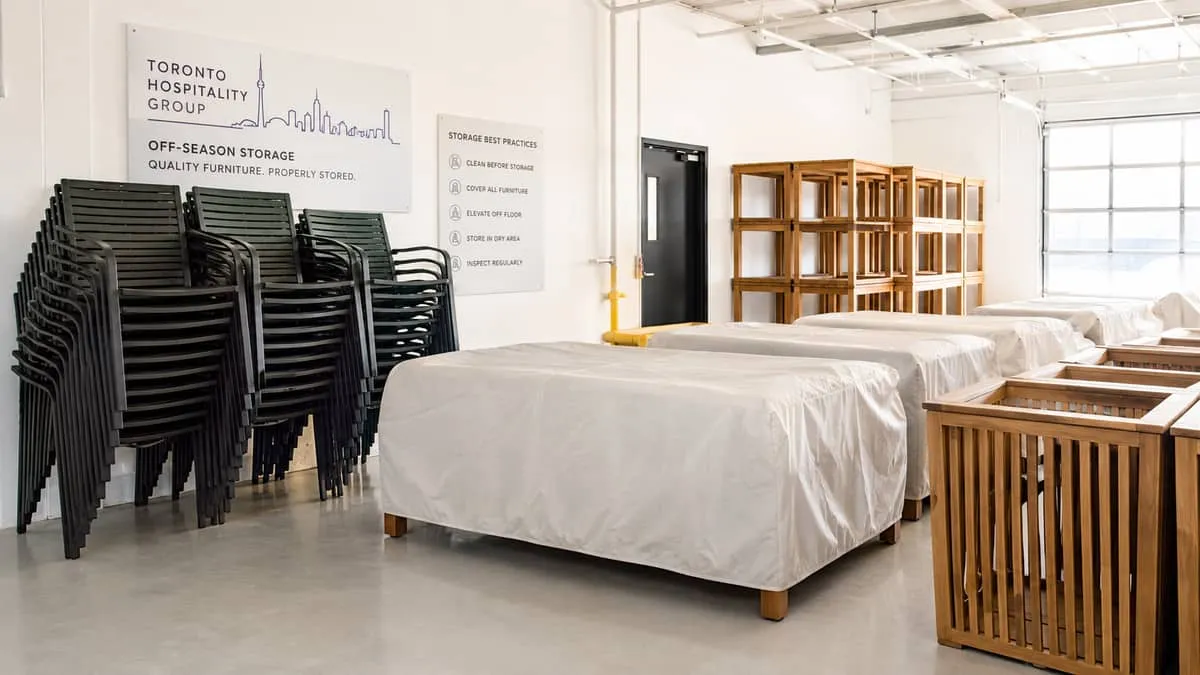
Powder-coated aluminum stacks compactly and can be stored in almost any dry interior space. Teak can remain outdoors through a Toronto winter if covered properly, though most operators bring it in to maintain the finish and extend the oil treatment cycle. Cushions must always come in. Mold and mildew damage to Sunbrella fabric over a Toronto winter represents a complete replacement cost, and that cost erases whatever was saved on the furniture purchase.
Before finalizing any furniture order, measure the actual storage space your operation has available. Sixty stackable chairs take less room than most operators expect. Sixty tables do not stack at all unless they are specifically specified with folding mechanisms. A 60-table patio that has not planned for table storage has a problem that furniture quality cannot solve.
Lead times are a structural reality in the commercial patio furniture category. Quality contract-grade aluminum and teak from proper commercial suppliers typically carries eight to sixteen weeks from order to delivery. Operators planning for an April opening on a King West or Distillery patio need to be placing orders no later than January to have certainty of delivery before the licensing season begins. The operators who call in March looking for a spring delivery are working with whatever is in stock, which is a constraint on both selection and price.
Sourcing Commercial Patio Furniture for Toronto Operations
The gap between residential outdoor furniture and commercial contract-grade outdoor furniture is not subtle. It is visible in frame gauge, in weld quality, in the fabric and foam specifications for cushions, and ultimately in how long the furniture looks and functions at the standard Toronto hospitality operations require.
When evaluating suppliers for a Toronto patio project, ask specifically for references from licensed patio operations in this city. A supplier who has outfitted patios in the King West corridor or the Distillery District understands the climate performance requirements, the licensing context, and the storage logistics that a general outdoor furniture company does not. Ask for warranty terms on frames and fabrics separately, confirm minimum order quantities align with your project scale, and ask about lead time commitments in writing.
Some commercial suppliers serving the Greater Toronto Area offer seasonal storage programs, end-of-October pickup and spring delivery, which is worth asking about if storage is a genuine operational constraint for your property. For properties doing a full patio renovation or a first-time licensed patio build-out, a supplier who can consult on the floor plan alongside the furniture selection will prevent the configuration problems that show up at licensing inspection.
Toronto's patio season is a defined window, and it is competitive. The operators on King West, in Yorkville, along the Harbourfront, and through the Distillery who invest in furniture that performs consistently and looks right across the full season are the ones holding onto their licensed square footage and the revenue that comes with it.
If you are sourcing commercial patio furniture for your Toronto property, the fastest way to real numbers is to tell us what you need. Request a quote with your quantities and timeline.
Related reading
- What is contract furniture
- Commercial furniture vs retail
- Hospitality furniture supplier guide
- Outdoor dining chairs
- Patio and terrace tables
- Browse full catalog
Our take
Two different kinds of stacking demand run through this piece without being named as different. Licensed King West sidewalk patios have to be fully packed away nightly under some permit conditions, meaning that furniture stacks and unstacks every single service day for a five to six month season. Distillery District and waterfront patios, by contrast, are described in the same post mainly around seasonal storage, one breakdown at the end of the season rather than nightly. A King West patio and a Distillery District patio of equal chair count are not doing the same amount of physical handling over a season, the King West inventory is cycling through an order of magnitude more stack and unstack events, and the durability spec should be weighted for that difference rather than treated as one regional standard.
The bottom line: Furniture for licensed patios requiring nightly clearance, such as King West sidewalk locations, should be specified for stacking cycle durability at a level well above what a seasonal-storage-only Distillery District or waterfront patio of the same size actually needs.