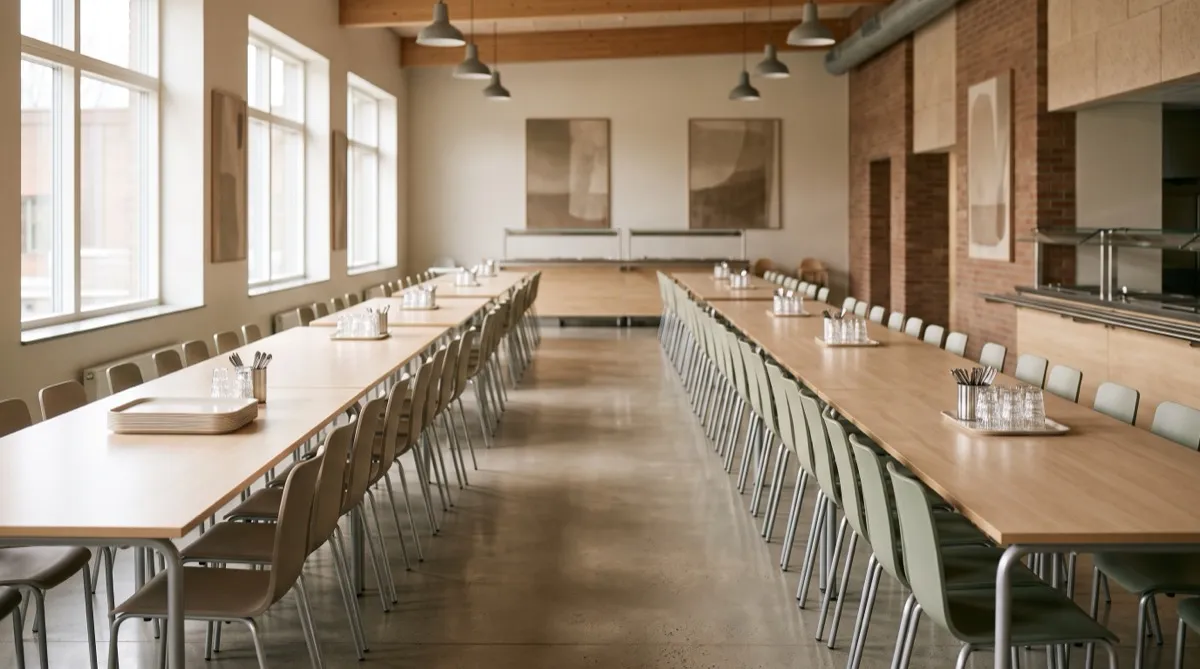
A campus buys furniture on a clock that almost nothing else on the operations calendar has to obey. The classrooms, the library, the dining commons, and the residence halls all have to be ready when students arrive, which means the real ordering, receiving, and installing happens inside a summer window that is shorter every year. A procurement officer who understands that window plans backward from it, and everything about a volume furniture order flows from that discipline.
The other constant is the purchase order. Public schools and universities buy through a process with approvals, bid thresholds, and documentation, and furniture that cannot be quoted cleanly against a spec creates work for everyone. The upside is that furniture is a natural fit for volume purchasing: the quantities are large, the specifications repeat across dozens of identical rooms, and the buyer benefits from standardizing rather than customizing every space.
The quantities are room-multiplied
Campus furniture math is multiplication. A single classroom spec, a student chair and a table or desk, becomes a real number once you multiply by the count of identical rooms in a wing or a building. A residence hall repeats a room package across every unit on every floor. That repetition is exactly why a campus should standardize: choosing one durable classroom chair and one table program, then buying them deep, is cheaper to source, cheaper to maintain, and cheaper to reorder than furnishing each room as its own project.
Different spaces still need different specifications. Classrooms and lecture rooms want stackable or mobile seating that reconfigures for exams and group work. Libraries and study commons want a mix of task seating and lounge pieces. Dining commons want tables and chairs built for constant cleaning and high turnover. The furniture cost calculator helps a procurement office scope these packages and see the drivers before a single purchase order is drafted.
Durability is measured in student-years
Define the intended student use and ask for the exact model's relevant test, loading, cleaning and handling documentation. Welded joints, reinforced frames and wipeable surfaces are construction details to assess, not proof of a decade in service or failure by spring. Include repair parts, inspection and observed maintenance costs in the procurement comparison.
Compare ownership cost with actual campus maintenance and replacement records. Ask the supplier to confirm parts and future compatibility for the selected line. The side-chair concepts are visual references, not verification of school-use testing or sizing.
Storage, stacking, and flexible rooms
Campus rooms rarely sit still. A classroom becomes an exam hall, a multipurpose room hosts orientation and then a lecture, a dining commons clears for an event. Seating that stacks and rolls is what makes those changes possible with a small crew, and stack height directly determines how much storage a building needs. Confirm the stacking depth, buy the dollies in the same order, and size the storage closet to the racks you actually purchased. These are small decisions that quietly govern how a building operates all year.
Why volume ordering fits a campus
Coordinate room specifications, quantities and the building-by-building summer receiving plan before requesting quotes. Ask suppliers whether they can consolidate freight and meet the phased schedule. The volume-order planning resources help prepare a request; CFD does not guarantee matching stock, consolidated deliveries or installation.
Staged delivery is especially valuable when a renovation and a normal turnover are happening at once. Furniture can arrive for the finished wing while another is still under work, so nothing sits in a corridor waiting, and the buildings open in the order they are ready.
Planning against the summer window
The one immovable fact is the start of term. A volume order made to a specification waits its turn in the factory, then travels as freight, then has to be received and installed, and all of that has to finish before students arrive. Procurement offices that count backward from move-in day, allowing real time for production and delivery, are the ones not improvising in August. Ordering early in the budget cycle, rather than waiting for the last approval, is the single best protection against a slipped opening.
Sample evaluation belongs in this timeline too. On a large standardization decision, getting the actual chair in front of the committee to sit in, test, and confirm before the full run is authorized is cheap insurance against furnishing an entire building around the wrong piece.
Getting to a quote
Settle the room specifications, multiply by room counts, and confirm the stacking and storage plan, then price the season as a package. Send the item list with quantities, finishes, a delivery address, and the install deadline, then request a quote against the actual scope. How many units, which freight lane, what grade, and how long production runs are what move the price, so the counts and the calendar lead everything else.