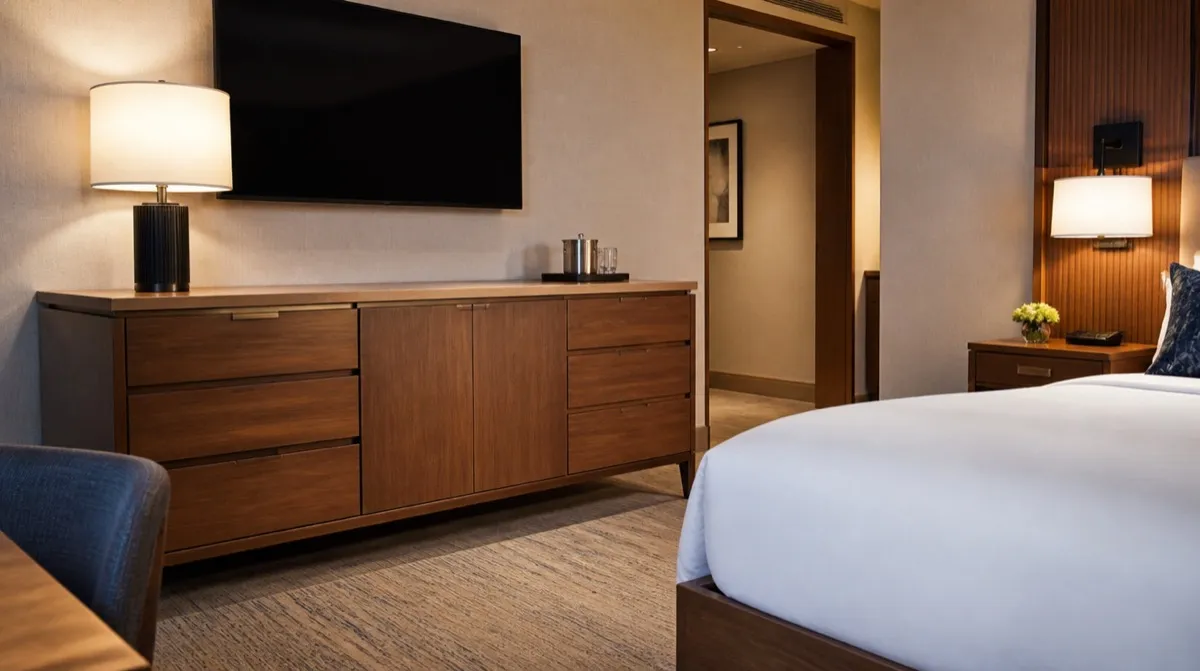
A guestroom dresser needs drawer, surface, hardware and stability specifications for the intended use and housekeeping routine. Room turnover alone does not establish drawer cycles, and no evidence here supports a general eighteen-month failure forecast. Follow the exact model's use and anchoring instructions; drawers are not automatically approved as climbing steps.
Dressers and drawer chests belong in the coordinated headboard, nightstand and wardrobe schedule. Review their mechanical and surface use separately; this guide supplies no failure-rate data establishing that dressers fail first in every guestroom.
Drawer glides are the single most important spec
Request the actual glide's load, extension, cycle-test conditions and replaceable-part details within the complete dresser assembly. A few thousand versus tens of thousands of test cycles is a comparison example, not a forecast of real service life. The 60 to 80 percent occupancy and ten-year holding-period assumptions do not establish drawer openings; use observed use/maintenance records and the selected model's documentation.
For soft-close glides, obtain the exact mechanism's load, cycle conditions, adjustment and replacement instructions in the complete dresser. Test noise and operation in the actual room. The feature alone does not establish reduced neighboring-room noise, slower joint loosening or a worthwhile premium at every property tier.
Weight capacity matters too. A drawer rated for folded clothing is fine for most guestroom use, but properties running extended-stay or corporate housing programs should confirm a higher capacity rating, since long-stay guests store more and heavier items than a two-night leisure guest.
Edge banding and corner construction
The failure point on most casegoods is not the flat surface, it is the edge. Every drawer front, top, and side panel has an edge where the laminate or veneer meets raw substrate, and that edge takes impact from luggage, vacuum cleaners, and furniture being repositioned during deep cleans.
Obtain the exact edge material, thickness, adhesive, radius and repair instructions with the case/joint documents. PVC, hot-melt, taped, painted, screwed/glued or stapled labels alone do not establish a five-year appearance or universal failure ranking. Inspect and test the approved sample under the actual housekeeping/contact routine.
Surface material and finish
Compare the exact HPL, thermofused-melamine and other proposed finish assemblies against the housekeeping cleaners, contact and repair needs. A material label alone does not establish chemical compatibility, a lower price or a faster wear rate. Obtain the maker's care limits and test an approved sample.
For a veneer finish, obtain the actual substrate, coating and maker-approved cleaner instructions rather than assuming catalyzed or UV-cured labels cover every chemical. Test the approved finish against the housekeeping procedure; no evidence here establishes a first-year failure date for every mismatch.
Matching the set and hardware
Record approved casegoods model, grain/tone, finish samples and hardware across the room package. A single supplier does not automatically guarantee matching batches or future reorders. Browse dresser concepts for appearance references, then verify the real dresser/nightstand/headboard combinations with the supplier.
Pull hardware should be commercial-duty and screwed through the drawer front with a backing plate, not a thin decorative pull that loosens after repeated pulling at an angle, which is how most guests actually open a drawer.
Drawer count and configuration by room type
Standard king and queen guestrooms usually run a four to six drawer dresser paired with a separate luggage rack or bench, while extended-stay and suite configurations often need a larger chest with additional deep drawers for longer guest stays. Sizing the drawer count to the actual guest profile matters more than defaulting to whatever configuration the last renovation used. A leisure-heavy resort property gets more value from wide, shallow drawers sized for folded clothing, while a corporate extended-stay property benefits from at least one deep drawer that can hold bulkier items.
Combination pieces that pair a dresser base with a mounted TV shelf or a fold-out desk surface are increasingly common in limited-service and select-service brands looking to consolidate casegoods into fewer pieces per room. If your brand standard is moving toward combination units, confirm the weight rating on any surface meant to double as a desk, since a dresser top built only for a television is not automatically rated for a laptop and a guest leaning on it.
Budgeting the replacement cycle
Treat 10 to 14 weeks as a provisional casegoods schedule example. Confirm exact stock, minimums, finish approvals, production and delivery dates for every phase. Retain model, finish and approved-sample records and verify later batch matching with the supplier rather than assuming the same specification guarantees identical appearance.
Submit a furniture request with room-type quantities, drawer/load requirements, approved finishes, model-document needs and phase dates. Independent suppliers may confirm actual casegoods, glide specifications, commercial-use terms and delivered quotes directly.