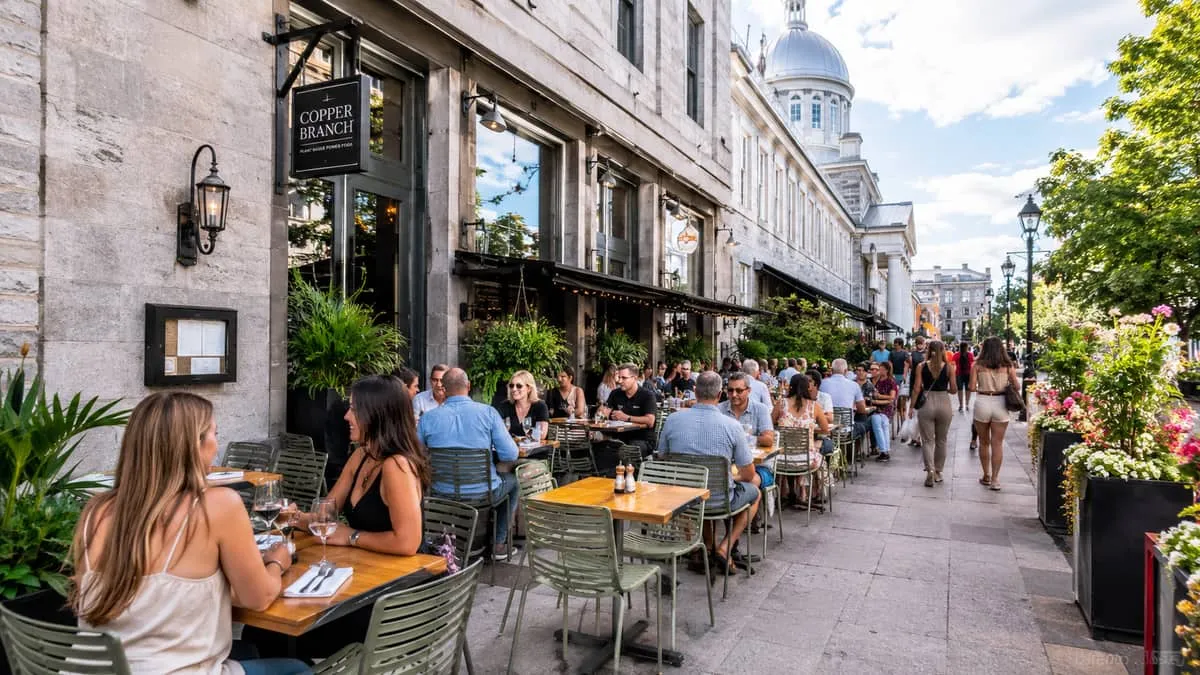
Montreal takes its terrasses seriously. Not as a seasonal amenity, not as a weather-permitting bonus, but as a civic institution that defines how the city eats, drinks, and socializes from May through September. A restaurant on Saint-Laurent without a terrasse is structurally disadvantaged. A hotel in Old Montreal with a poorly outfitted courtyard is leaving revenue on the table during Jazz Festival weekend when rooms are full and guests want somewhere to drink. A rooftop bar in Griffintown with furniture that looks cheap against a skyline view will get photographed for the wrong reasons. The terrasse question in Montreal is not whether to invest in outdoor seating. It is what the right furniture looks like for each specific context in one of Canada's most design-literate hospitality markets.
The challenge for operators is that Montreal's outdoor seating contexts are not interchangeable. A Plateau bistro on Mont-Royal faces entirely different furniture requirements than a rooftop bar on a Griffintown condo hotel, and both are different from a Hotel Nelligan courtyard in Old Montreal. Getting this right means understanding what each environment actually demands, not sourcing a generic product and hoping it performs.
The Plateau Terrasse: Style, Density, and Five Months of Freeze-Thaw Storage
The Plateau-Mont-Royal restaurant corridor is where Montreal's independent dining culture is most concentrated and most competitive. Along Mont-Royal Avenue and Saint-Laurent Boulevard, terrasses sit directly on high-pedestrian streets where passerby assessment is a constant sales pressure. A terrasse that looks good from the sidewalk fills faster. One that looks worn or generic does not pull street traffic the same way, and in the Plateau, street traffic is a significant part of how a restaurant fills on a Tuesday.
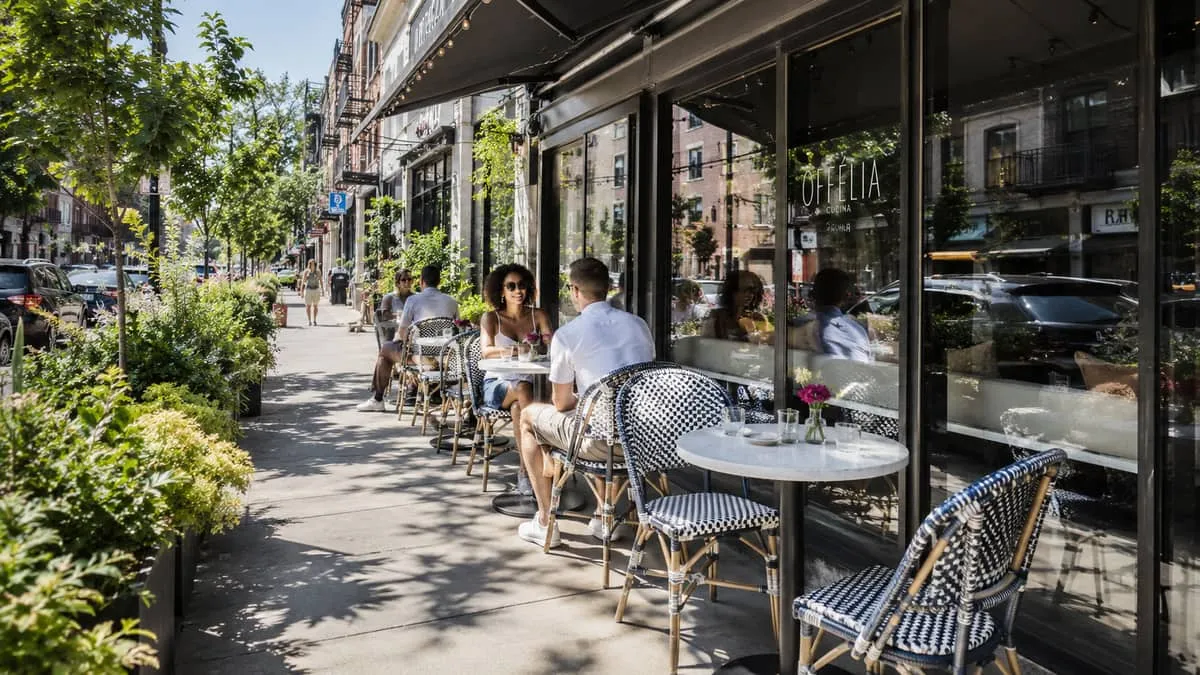
The furniture requirements here are specific. Space is almost always constrained. City-licensed terrasse footprints on these corridors are measured carefully, and every square foot has to produce covers. Bistro tables at 60 cm round are the workhorse of this context, allowing operators to maximize the linear density of a sidewalk terrasse without making it feel cramped. They pair with armless bistro chairs, ideally in stacking aluminum, for maximum flexibility during service. When a reservation for six arrives and you need to push two tables together, you want chairs that move quickly. When a storm is coming at 6 PM on a Saturday, you want staff to be able to break down the terrasse in under fifteen minutes.
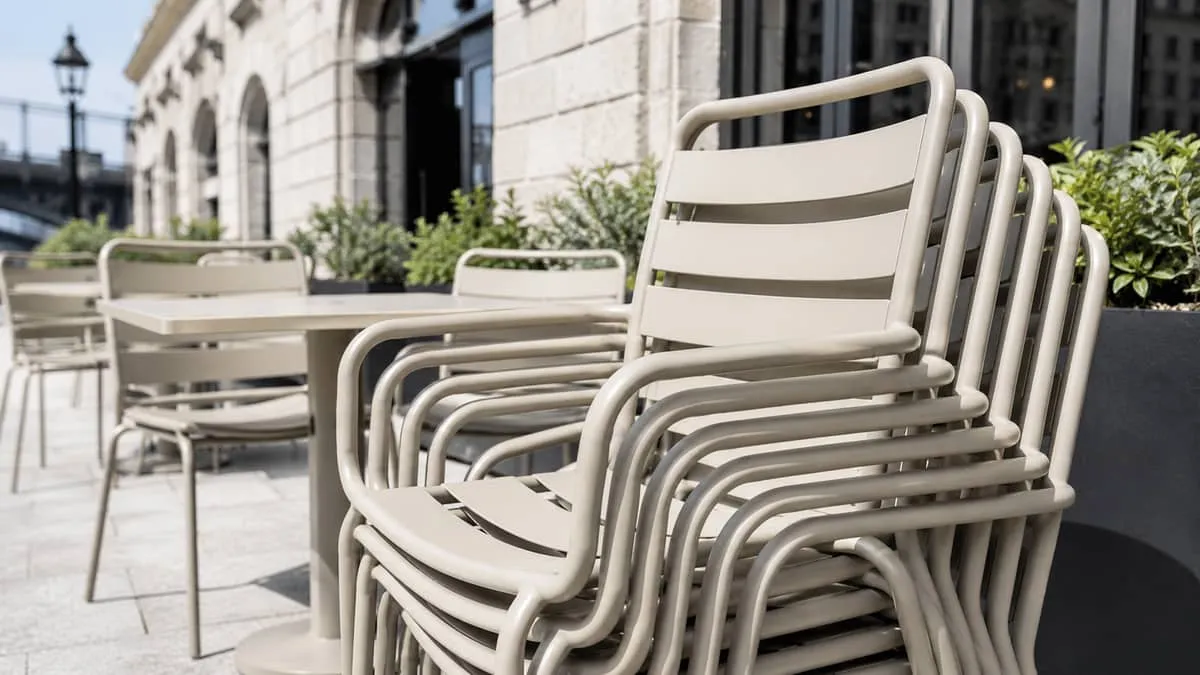
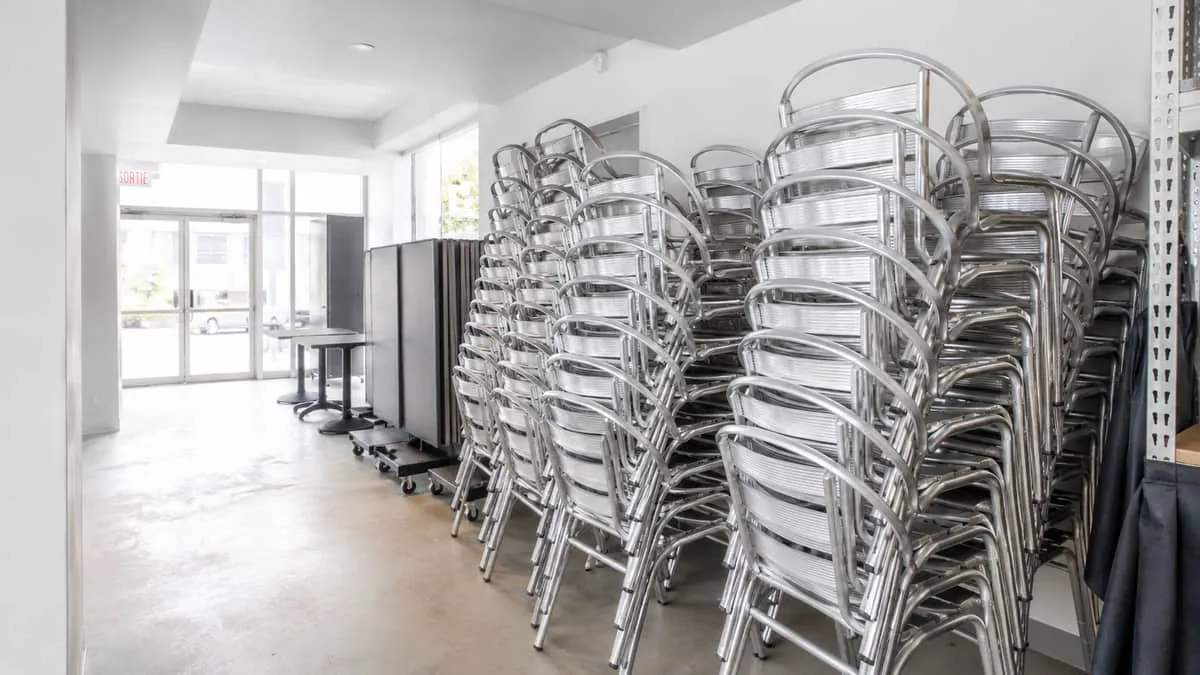
The freeze-thaw storage reality is what separates a smart furniture purchase from an expensive mistake in this market. Montreal chairs and tables spend roughly five months in storage for every seven in active service. Powder-coated aluminum is the frame material that handles this ratio best. It does not rust through a Montreal winter. It does not warp under freeze-thaw cycling. It is light enough for a single server to reposition during a rush. And stacking aluminum chairs collapse into compact rows that fit in a back hallway or utility closet without consuming square footage the restaurant needs for other purposes. Commercial contract-grade aluminum frames, properly maintained and stored, should return ten years of reliable service in this climate. That lifespan math matters when you are comparing upfront costs.
On the Plateau, the aesthetic expectation is also higher than in many markets. This is a neighbourhood with serious food culture and a dining public that notices design. Matte black and warm charcoal powder coats read well on Saint-Laurent. Bistro-weight frames with slightly curved profiles have the right proportion for the neighbourhood's European dining character. Resin wicker in neutral tones works on properties with more garden-style terrasse layouts. Whatever the direction, the furniture needs to look intentional from the sidewalk, because that is exactly how it will be evaluated.
Fabric selection on the Plateau follows from the same weather reality. Cushioned seating for terrasse dining chairs is common on properties that want a softer look, but the fabric specification is not optional: solution-dyed acrylic, Sunbrella or equivalent, is the only category that performs reliably through a Montreal summer of afternoon rainstorms, high UV exposure in peak July, and the mildew risk that comes from furniture that gets rained on and does not fully dry before service the next morning. Removable covers with zippered enclosures let staff pull cushions quickly before a storm and store them inside, significantly extending the life of the fill material. Many high-volume Plateau lunch spots skip cushions entirely on their dining chairs and use a well-profiled aluminum or resin wicker seat that works for the duration of a meal without requiring upholstery management.
Old Montreal: Cobblestone Stability and Heritage Property Constraints
Old Montreal operates under a different set of physical and regulatory constraints than any other neighbourhood in the city. The heritage character of the Vieux-Port corridor, the narrow cobblestone lanes around Place Jacques-Cartier, and the courtyards behind properties like Hotel Nelligan and Auberge du Vieux-Port create outdoor seating environments that do not respond well to standard terrasse furniture approaches.
The cobblestone surface issue is the most immediate practical challenge. Uneven historic paving means that four-legged tables and chairs without leveling mechanisms will rock, which is a service liability in fine dining contexts and an aesthetic problem in any context. Commercial patio furniture with adjustable leveling glides on the base legs is the functional requirement here, not a nice-to-have feature. Wide-base pedestal table designs also perform better on uneven surfaces than four-leg alternatives, reducing the rocking problem at the source rather than compensating for it with adjusters on every leg.
The weight and permanence tradeoff is also different in Old Montreal. Heritage hotel properties with flagstone or cobblestone courtyards are often running a more composed, design-deliberate aesthetic than a casual Plateau terrasse. Teak furniture earns its cost premium in this context. It reads as premium to hotel guests, develops a natural grey patina if left untreated that actually works well against historic stone surfaces, and has the visual weight that suits a courtyard rather than a sidewalk. The maintenance obligation is real: annual oiling to preserve the warm honey tone, proper covered storage or tarping through winter, and the acceptance that teak's weight means it moves slowly and requires planning. For a boutique hotel property that is protecting a guest experience and a visual identity, that trade-off is often worth making.
Properties along the Vieux-Port waterfront face an additional consideration: wind exposure from the St. Lawrence increases significantly on open terrace sections, and lighter furniture needs ballasting or anchoring solutions when it sits without natural wind protection from buildings. Heavier teak or wrought iron base tables are inherently more stable. Aluminum furniture on open waterfront sections may need weighted base inserts or tie-down systems for anything that would be left out overnight.
The Old Montreal terrasse market is also where Grand Prix weekend and Jazz Festival season create the highest revenue concentration in the city's hospitality calendar. Properties in this area are filling their outdoor spaces at peak capacity during both events, with guests who are evaluating the experience against international hotel and restaurant standards. Furniture that looks appropriate for the setting and holds up through three consecutive nights of capacity service is a minimum expectation, not an aspirational standard.
Griffintown and Downtown Rooftop Bars: Wind Load, Building Code, and Skyline Visibility
Griffintown's development over the past decade has added a concentration of condo hotels, boutique properties, and bar-restaurant concepts with rooftop patio access that did not exist in the neighbourhood fifteen years ago. The downtown rooftop bar market, extending through properties near McGill and up toward the Sherbrooke corridor, represents a furniture specification context that is genuinely distinct from street-level terrasses.
Wind exposure is the primary engineering concern. A rooftop patio in Griffintown at six or eight stories elevation operates in a different wind environment than any ground-level terrasse, and furniture that performs fine on a sheltered sidewalk becomes a safety liability when it catches a sustained gust. Commercial patio furniture specified for rooftop installations needs minimum weight thresholds or anchoring systems, and operators should be verifying that their furniture supplier has experience with rooftop applications specifically. Lightweight stacking chairs that are ideal for a Plateau bistro are not the right product for an exposed rooftop without additional ballasting or securing. Heavier aluminum frames, cast iron bases, and concrete or weighted pedestal table bases are all approaches used to manage this, depending on the visual direction of the space.
Building code requirements in Quebec for rooftop occupancy spaces add another specification layer. Guardrail and railing configurations affect how close furniture can be positioned to perimeter edges. Capacity calculations for the structural load of a fully furnished and occupied rooftop terrace are part of the permitting process for these installations. These are conversations to have early in the furniture selection process, not after an order has been placed.
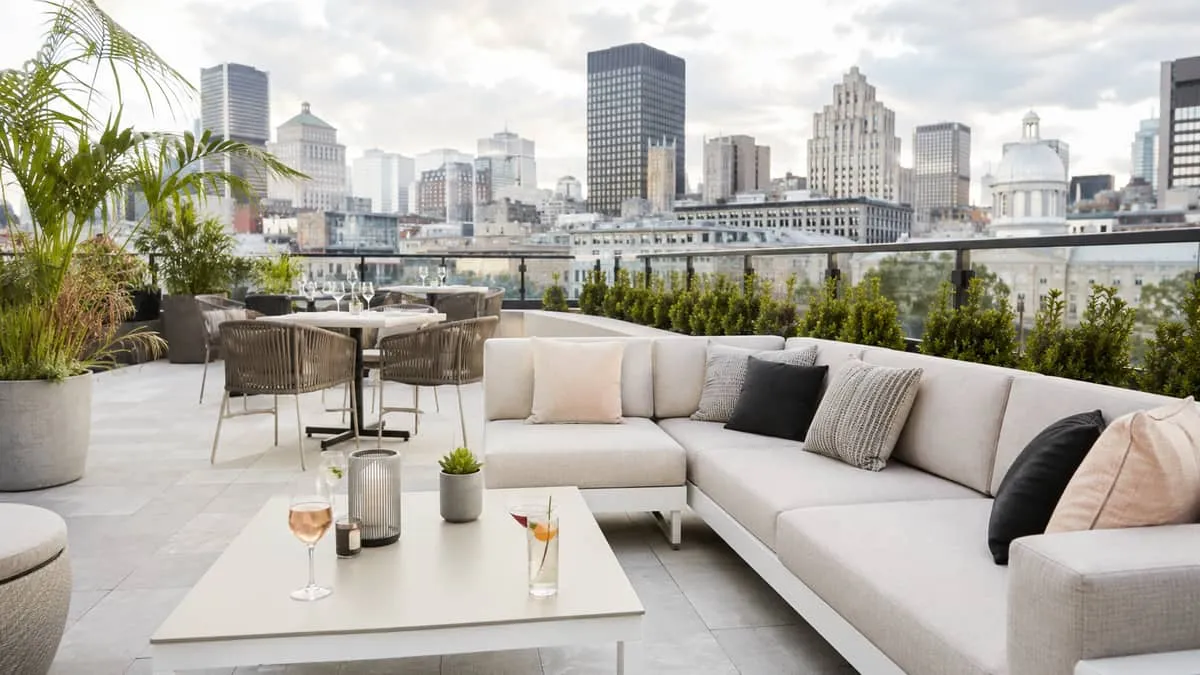
The aesthetic expectation on Griffintown rooftops is different from the Old Montreal heritage context. These spaces are positioning against a contemporary city skyline and a guest demographic that includes the tech and creative sector workers who have driven the neighbourhood's development, along with visitors to the boutique hotel properties that have followed the residential boom. Deep sectional lounge seating in weather-resistant performance fabric, low-profile side tables, and fire table features are the product categories that work for this segment. The goal is an outdoor lounge environment that holds guests for multiple rounds and generates photo content organically. A sectional with well-specified Sunbrella fabric in a muted contemporary palette against a Griffintown skyline view is a commercial decision that pays back in social content reach in addition to direct beverage revenue.
Bar-height seating along rooftop railings, where building code permits it, creates a natural viewing position that is popular with guests and operationally efficient. Counter-height stools with a footrest and modest back support outperform backless bar stools for any situation where guests are staying through more than one drink, which is most rooftop bar service. The footrest and back support reduce fatigue enough that guests stay seated longer, which translates to higher per-visit spend.
Little Italy, Mile End, and the Neighbourhood Restaurant Terrasse Market
Montreal's independent restaurant culture extends well beyond the Plateau and Old Montreal corridors. The Little Italy trattoria concentration along Saint-Laurent north of Jean-Talon, the Mile End coffee shop and bistro scene around Saint-Viateur and Bernard, and the Gay Village entertainment district along Sainte-Catherine Est each have their own terrasse character and their own furniture logic.
Little Italy trattorias benefit from the same European dining cultural influence that shapes the broader Montreal restaurant market, and their terrasses often lean into that reference: warm timber tones, traditional wrought iron bistro profiles, and coloured canvas umbrellas that signal the trattoria aesthetic from the street. The furniture specification in this context is doing brand work as much as functional work.
Mile End coffee shops and wine bars are operating in a neighbourhood with a strong design sensibility and a clientele that will notice furniture that looks out of place with a carefully developed interior identity. The terrasse has to read as a continuation of the interior, which means the furniture selection process starts with the interior design direction rather than with a furniture catalogue. Mismatched terrasse furniture is one of the more common ways operators undermine an otherwise coherent brand environment.
The Gay Village entertainment district runs high-volume service across a long day and evening window during peak summer, particularly around Fierté Montréal in early August. Durability and stackability are the priority here over premium materials. High-turnover service in an entertainment district context wears furniture faster than a fine dining environment, and operators need products that can handle the volume without visible wear by the end of the season.
Sizing, Layout, and the Covers-Per-Square-Foot Calculation
Across all of Montreal's outdoor dining contexts, one of the most consistent sourcing mistakes is furniture that is slightly oversized for the actual licensed footprint. Bistro tables at 60 cm round allow tighter linear spacing than 70 cm alternatives without making the experience feel cramped. Four-tops at 70 by 120 cm work for most dining contexts and can push together for groups of six or eight during Jazz Festival reservations. These dimensions are worth specifying deliberately rather than defaulting to whatever a supplier shows as standard.
For operators doing a first terrasse installation or replacing aging inventory, a furniture layout plan based on the licensed footprint before ordering is worth the time. The difference between fitting fourteen covers and eleven covers on a Plateau terrasse is meaningful revenue across a five-month season, and it is often a function of table sizing rather than the footprint itself.
Montreal's terrasse season is short enough that every week of it counts. The furniture decisions made before opening day, on frame material, fabric specification, footprint configuration, and storage planning, determine whether a terrasse operates efficiently and looks good through Labour Day or starts showing its age by mid-July. Getting the specification right for the actual neighbourhood and venue context is the work that makes outdoor hospitality investment in this city perform the way it should.
Planning commercial patio furniture for your Montreal project? Share your specs and quantities and we will build pricing around your actual program. Request a quote to get numbers for your space.