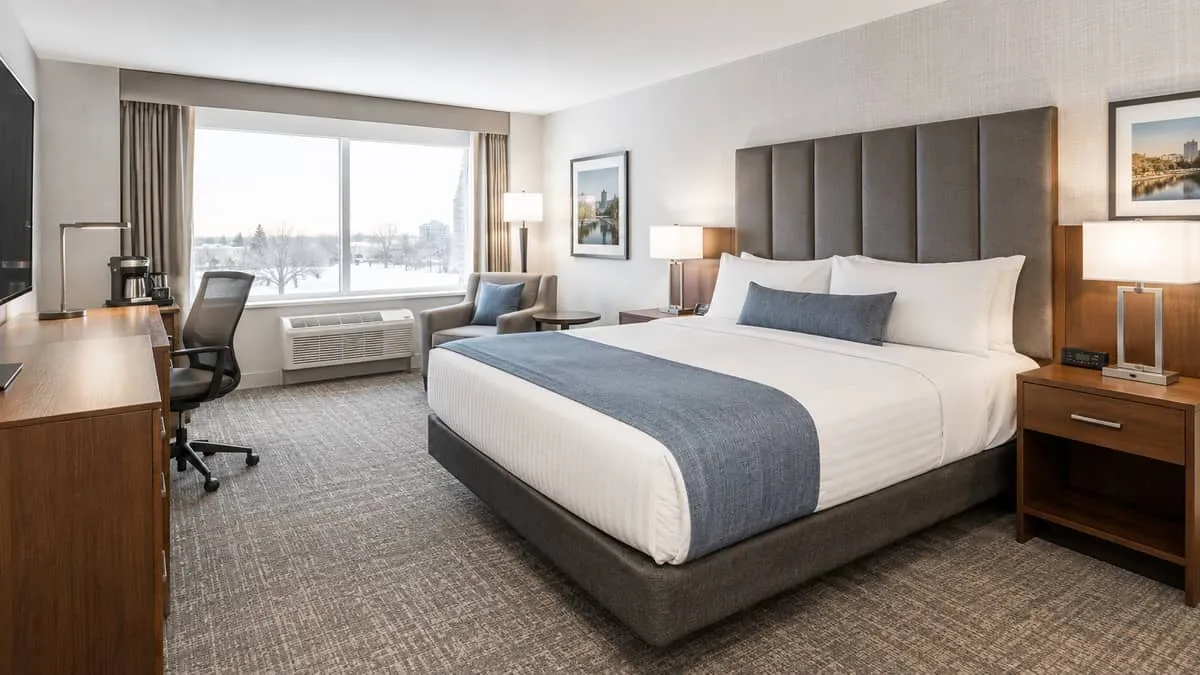
Winnipeg's hotel market splits in two, and knowing which side of that split you are on determines every procurement decision you make. On one side, you have heritage properties in the Exchange District and around the Fort Garry corridor, where operators are fitting furniture into century-old brick-and-timber buildings and competing on atmosphere as much as location. On the other, you have the True North Square development zone and the corporate corridor around Canada Life Centre, where properties are catering to insurance executives from Great-West Life and Wawanesa, government accounts, and the road warriors coming through on agriculture and manufacturing business from across the Prairies. Same city. Very different furniture briefs.
Then there is Winnipeg's climate, which changes everything regardless of which market segment you are in. No other major Canadian hotel market asks furniture to perform the way Winnipeg does. A property here runs its heating systems hard from October through April, which means interior relative humidity can drop into ranges that destroy solid wood furniture, buckle veneer edges, and crack finishes that would survive indefinitely in Vancouver or Toronto. Sourcing furniture for a Winnipeg hotel without accounting for that is one of the most common and expensive mistakes operators make.
The Exchange District Heritage Brief: Furniture That Earns Its Place in a Historic Building
The Exchange District is one of the best-preserved collections of early twentieth century commercial architecture in North America. When boutique operators renovate in this neighbourhood, or in adjacent areas along McDermot and Arthur streets, they are working inside buildings where exposed brick walls, Douglas fir beams, and original hardwood floors set a standard that cheap contract furniture immediately violates.
Furnishing a property adjacent to Hotel Fort Garry, or building a boutique concept in the Exchange itself, requires casegoods and seating that can read as considered and historically coherent without becoming reproductions. The better approach is furniture with clean lines, warm wood tones in walnut or white oak, and minimal hardware. Metal accents in brushed brass or matte black work in these spaces because they echo the industrial heritage of the neighbourhood without trying to imitate it.
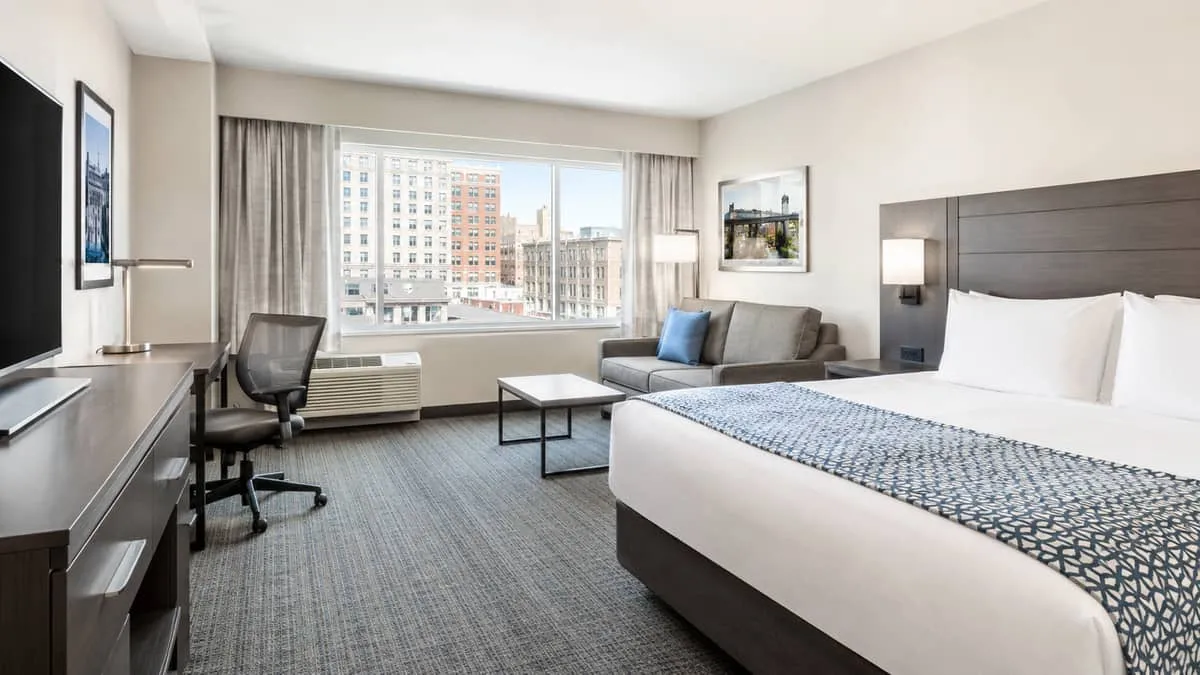
Operationally, Exchange District properties tend to run smaller room counts, which means FF+E orders that fall into the 20 to 40 room range rather than full-scale hotel builds. Not every contract furniture supplier works comfortably at that scale. When you are sourcing for a boutique property in this market, confirm minimum order quantities upfront. A supplier calibrated for 150-room corporate builds may not offer the specification support or lead time flexibility a smaller heritage project requires.
The structural requirements in these buildings also matter. Furniture arriving on freight elevators with tight clearances or being carried up original staircases needs to be specified with that constraint in mind. Modular casegoods or pieces designed for disassembly are worth specifying even if they cost slightly more, because the alternative is damage during installation that a supplier will not cover under warranty.
The True North Square Corporate Brief: Durability for High-Rotation Business Travel
The Alt Hotel at True North Square is a useful reference point for what the corporate Winnipeg market actually wants: efficient layouts, durable finishes, and a room that feels contemporary without requiring staff time to maintain it. Business travellers from the insurance sector, provincial government accounts, and agricultural industry visitors booking through True North Square and the surrounding development corridor are not looking for atmosphere. They are looking for a desk that functions, a bed that does not creak, and a chair that holds up after hundreds of guests have dropped their bags and work laptops on it.
For this segment, the specification priorities shift toward performance over aesthetics. Upholstery fabric on seating and headboards should be rated at 50,000 double rubs minimum, with preference for solution-dyed or performance weaves that resist the staining that comes from food delivery, coffee, and travel gear. Casegoods in a corporate property see more daily impact than most operators plan for: drawer slides need to be rated for commercial load cycles, desk surfaces need to resist the heat from laptops and the abrasion of power adapters dragged repeatedly across the same area.
The Canada Life Centre entertainment district also means these properties spike in occupancy around events, which accelerates wear in ways that calendar-based replacement cycles do not account for. Furniture specified for 8 to 10 year service life in a stable occupancy environment may realistically need replacement in 5 to 6 years in a property that runs heavy event-driven peaks. Build that into your ROI calculations when comparing product tiers.
How Winnipeg Winters Change the Furniture Specification
No other Canadian hotel market presents the same combination of extreme cold outside and aggressive forced-air heating inside. Winnipeg hits minus 30 Celsius with regularity from December through February. Properties run heating systems at high output for 7 to 8 months of the year, and interior humidity levels drop accordingly. That environment is genuinely hostile to furniture specified without consideration for it.
Solid wood furniture in these conditions will move. Panels crack, veneer lifts at edges and seams, and drawer fronts warp out of alignment. The solution is not to avoid wood-look furniture; it is to specify correctly. Furniture built on MDF or HDF core with high-pressure laminate or thermally fused melamine faces performs far better in low-humidity environments than solid wood or thin veneer over particleboard. Where solid wood is used, species selection and kiln-dry specifications matter. Hard maple and ash, dried to 6 to 8 percent moisture content and finished with penetrating oil rather than heavy film finishes, handle humidity cycling significantly better than softer species finished with polyurethane coats that crack and peel.
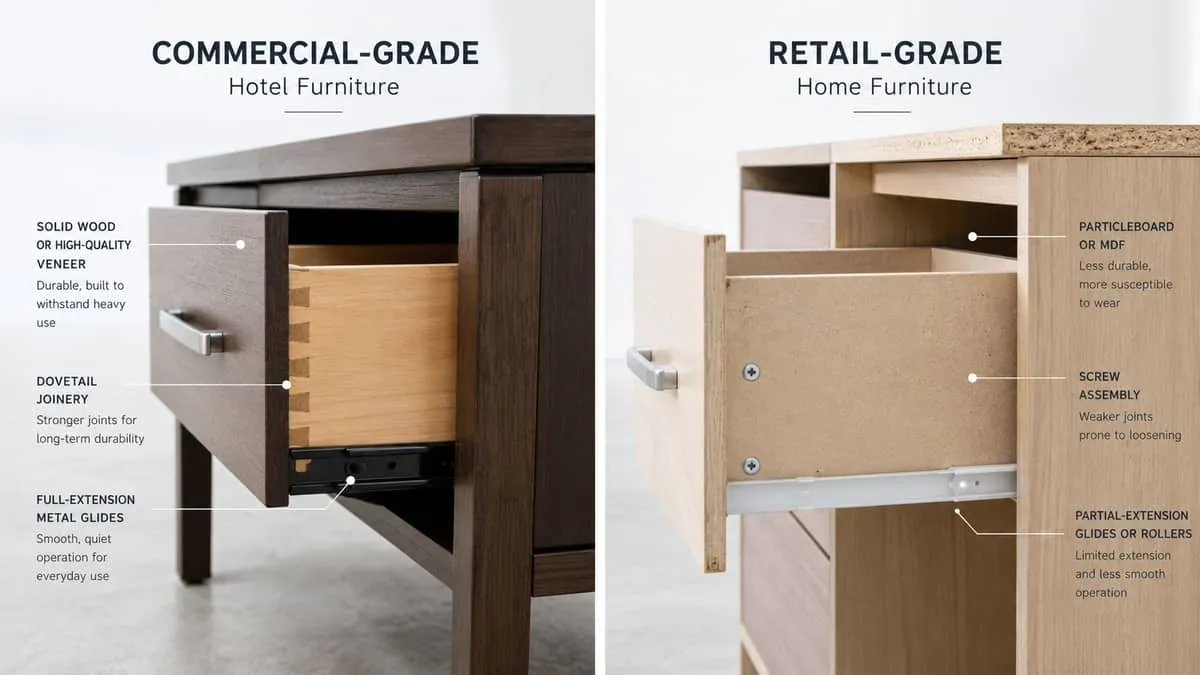
Ask your supplier directly how their product is rated for low-humidity environments. A supplier who has shipped regularly into Prairie markets will understand the question. A supplier whose references are all coastal properties may not.
Beyond wood movement, Winnipeg's winters shape the guest experience in ways that feed back into furniture decisions. The city is effectively an indoor city from November through March. Guests are spending more time in-room than they would in a milder climate, which increases wear on all surfaces. Seating gets more use. Desk surfaces accumulate more hours of actual work. The beds take more load from guests reading and working rather than sleeping and leaving. Spec for occupancy patterns that reflect actual Prairie winter behaviour, not national averages.
There is also the entry point problem. Guests arriving from minus 25 Celsius conditions are bringing in salt, moisture, and heavy outerwear. Rooms near ground-level entry points or in older properties with poor vestibule separation see salt tracking on floors and salt residue on furniture bases and legs. Furniture with feet or bases finished in materials that resist salt corrosion and moisture absorption performs noticeably better at these properties over a 3 to 4 year period.
Lead Times and Inland Freight: What Winnipeg Operators Actually Face
Most hospitality furniture, whether custom or semi-custom, runs 12 to 16 weeks from order confirmation to delivery. North American manufacturers can sometimes compress that to 8 to 10 weeks for standard configurations. Overseas sourcing adds 2 to 4 weeks of port and customs variability on top of production lead times.
For Winnipeg properties, the inland freight reality adds a layer that suppliers on either coast tend to underestimate. You are shipping to the geographic centre of the continent, which means freight costs are material and carrier reliability matters more than it does for coastal markets. Ask any supplier you are evaluating whether they have active carrier relationships into Manitoba, and ask for references from other Prairie clients. A supplier whose logistics network is built around serving Toronto and Montreal will not have the same freight options or predictability as one that ships into Winnipeg regularly.
Phased renovations are common in Winnipeg because the renovation window is constrained. Properties typically do not want to pull rooms out of service during the peak winter occupancy period from January through March, or during the summer festival season when The Forks and Exchange District properties fill around events. That leaves a meaningful renovation window in April through June, and a secondary window in September and October. If you are doing phased work across multiple windows, your supplier needs to be able to hold pricing and maintain product consistency across orders placed 6 to 12 months apart. Get that commitment in writing.
Evaluating Suppliers for the Winnipeg Market Specifically
Price is the obvious filter in any procurement process, but for Winnipeg properties it is not where the real risk lives. The more important evaluation criteria are climate competence, Prairie logistics experience, and specification support quality.
On climate competence: ask suppliers specifically how their product performs in low-humidity forced-air environments. Ask for references from Manitoba, Saskatchewan, or Alberta properties where applicable. If a supplier cannot point to Prairie references, you are taking on product risk that their warranty coverage will likely not protect you from.
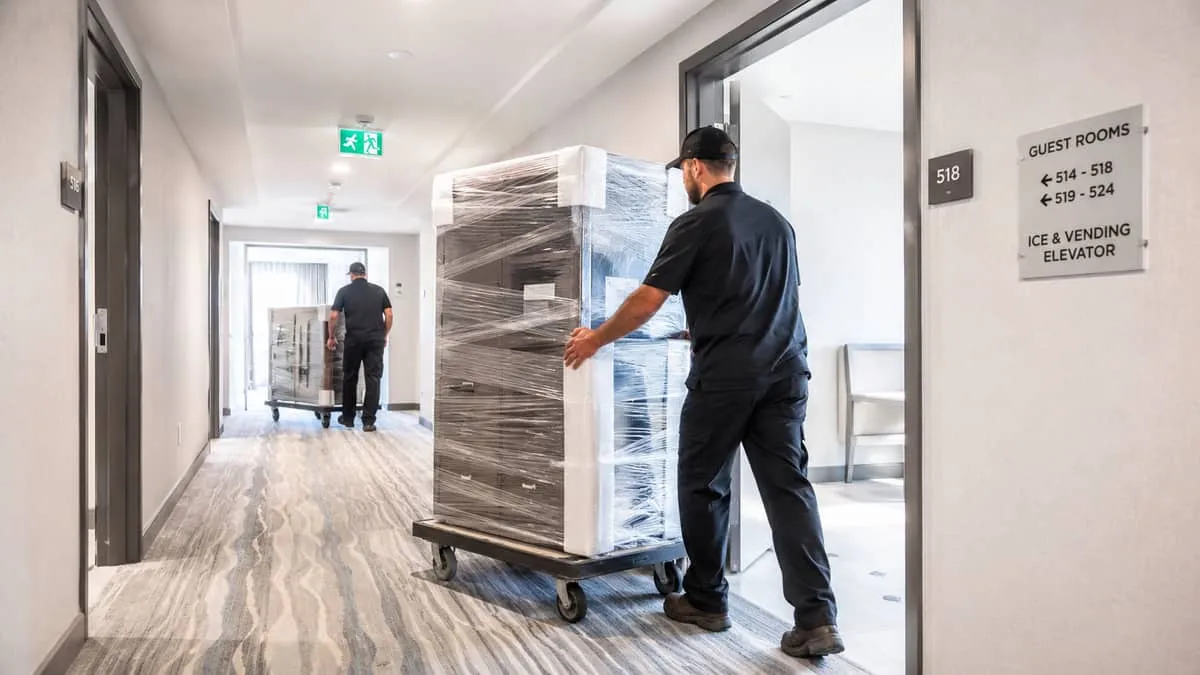
On Prairie logistics: confirm who handles final-mile delivery into Winnipeg, whether they use their own trucks or third-party carriers, and what their claims process looks like for freight damage. Damage during inland freight is more common than suppliers acknowledge in their sales process, and the dispute resolution path for a damaged casegood delivered to a Winnipeg property can be significantly slower than the same situation in a coastal market with more carrier options.
On specification support: a strong supplier helps you build a proper FF+E document before you commit to product. They cross-reference finishes with your designer's selections, provide physical samples and finish boards, and flag durability concerns before they become post-installation problems. For the Exchange District heritage context, that specification support should include guidance on how finishes photograph and read under warm incandescent and Edison-style lighting, which is common in that neighbourhood's aesthetic. For the corporate True North Square context, it should include honest guidance on which upholstery grades will realistically hold up against the occupancy profile you are projecting.
Warranty coverage deserves its own scrutiny. A five-year structural warranty is standard language in most supplier contracts, but the exclusions often cover finish wear, hardware failure, and damage attributed to cleaning products or humidity. Get the warranty in plain language and ask specifically what the claims process looks like if you have a problem 18 months into service. Is there a regional representative who can assess issues in Winnipeg, or does every claim require shipping product to a warehouse in Ontario?
The Forks and Assiniboine Park: Hospitality Adjacent Contexts
Not all furniture procurement in Winnipeg is strictly hotel rooms. The Forks Market represents a significant hospitality adjacency, with food and beverage operators, event spaces, and retail concepts that require commercial seating and tables specified for heavy public use. Assiniboine Park's hospitality venues operate under different constraints: they serve seasonal peaks in summer and during the Zoo Lights winter event, which means furniture that handles both outdoor-adjacent summer use and heavy winter indoor occupancy in the same calendar year.
For these contexts, the commercial furniture specification priorities overlap with hotel work but diverge on durability ratings. Public-facing seating in a Forks-area food hall needs to meet higher traffic assumptions than a hotel guestroom chair. Frame construction, seat foam ILD ratings, and fabric abrasion resistance all need to be specified at the upper end of commercial ranges. A supplier who works across both hotel and food and beverage contexts in Winnipeg can cross-apply that experience in ways that benefit both project types.
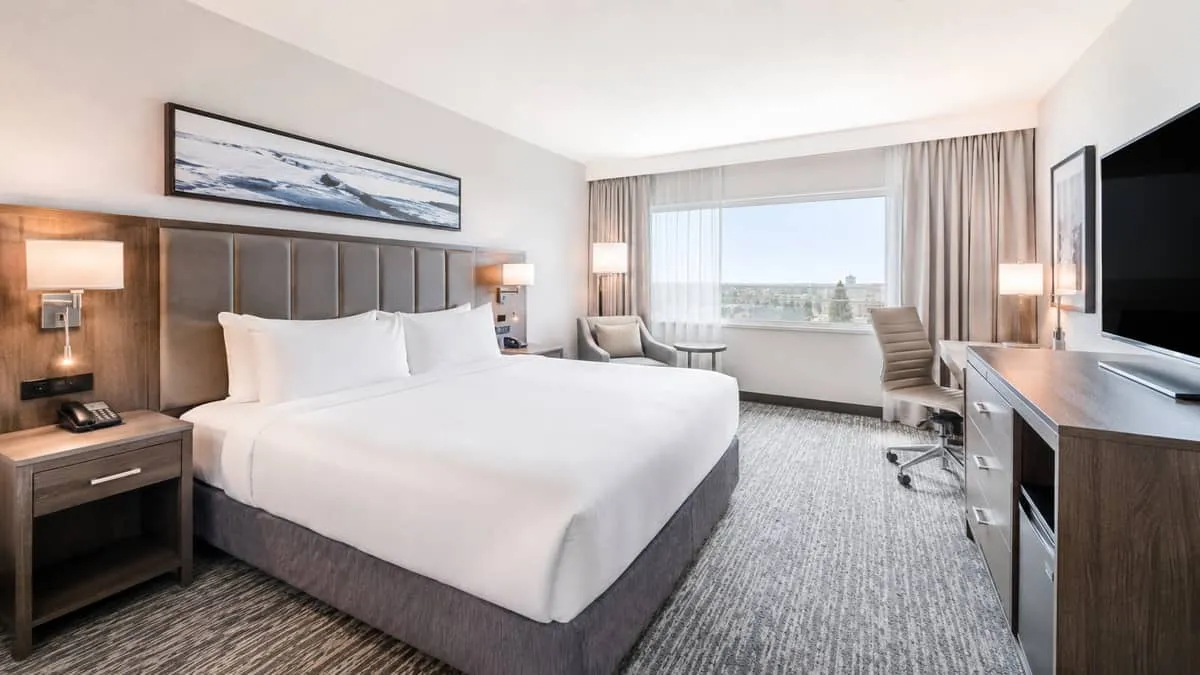
Building the Supplier Relationship for Long-Term Work
Winnipeg's hotel market rewards suppliers who treat it seriously. The city is not a secondary market to ignore between large coastal projects. Properties along Portage Avenue, the growing boutique sector in the Exchange District, the corporate corridor around Canada Life Centre, and highway properties serving travellers on the Trans-Canada and the routes north toward Thompson all represent consistent business for suppliers who show up with appropriate logistics capability and Prairie-specific product knowledge.
If you are in a renovation cycle, that is leverage. A supplier who sees you as a long-term account with phased work across multiple seasons is more motivated to hold pricing, prioritize your shipments in tight supply periods, and assign specification support rather than leaving you to work through a catalogue on your own. Communicate that you are building a multi-year relationship, not placing a single order, and then follow through by giving them the next phase when they perform.
The supplier relationship in this market is not a transaction. It is a vendor partnership, and like any partnership it requires clear specifications, honest timelines, and direct communication when scope changes. Furniture that performs for 8 to 10 years in a Winnipeg property, through extreme heating seasons, high event-driven occupancy, and the particular demands of guests who spend more time in-room than the national average, is not a commodity purchase. Treat it accordingly.
Ready to spec hotel furniture for your Winnipeg project? Send us the details and we will price it around your requirements. Request a quote to start.