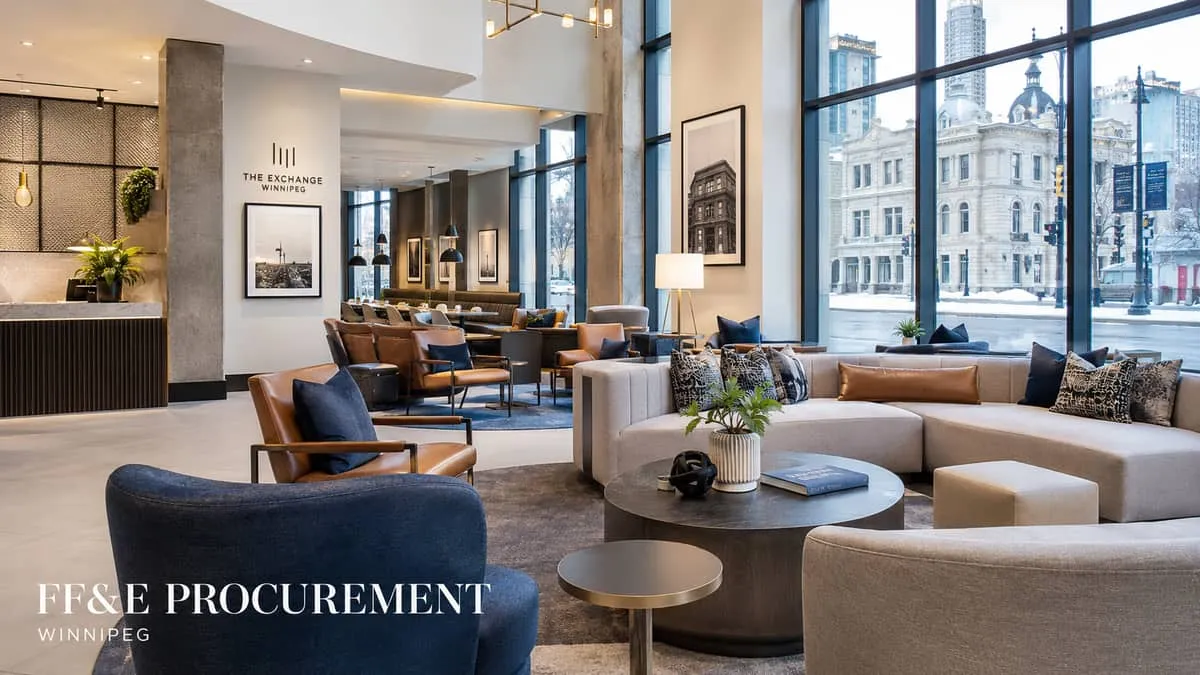
Winnipeg is in the middle of its most consequential downtown hospitality development in a generation. True North Square has reshaped what corporate travel looks like in the city. Alt Hotel opened steps from Canada Life Centre and immediately set a new benchmark for what mid-market hospitality can look like in a prairie market. The Forks continues to evolve as a year-round destination rather than a seasonal draw. And developers are moving into Exchange District heritage buildings with renovation scopes that would have been unthinkable fifteen years ago.
All of that activity means operators, developers, and ownership groups in Winnipeg are running FF&E procurement cycles at a scale and pace the market hasn't seen before. The question is how to do it well in a city that sits far from major container ports, has a corporate account base dominated by government and insurance rather than tech or tourism, and experiences weather extremes that genuinely affect installation logistics.
This post covers what full FF&E procurement looks like for a new or substantially renovated Winnipeg hospitality project, and where the process differs from how it works in coastal or larger Canadian markets.
FF&E Scope in a True North Square Era Development
FF&E stands for furniture, fixtures, and equipment. In a hotel context, it covers every movable item that isn't structural: guest room beds and case goods, lobby seating and accent pieces, restaurant chairs and tables, lighting fixtures, drapery and window treatments, custom millwork, and artwork.
What it doesn't cover is OS&E, operating supplies and equipment. OS&E is linens, tableware, glassware, kitchen smallwares, front desk technology, and cleaning supplies. The distinction matters for budgeting and accounting, and blurring the line between them is one of the most consistent errors operators make on their first major project.
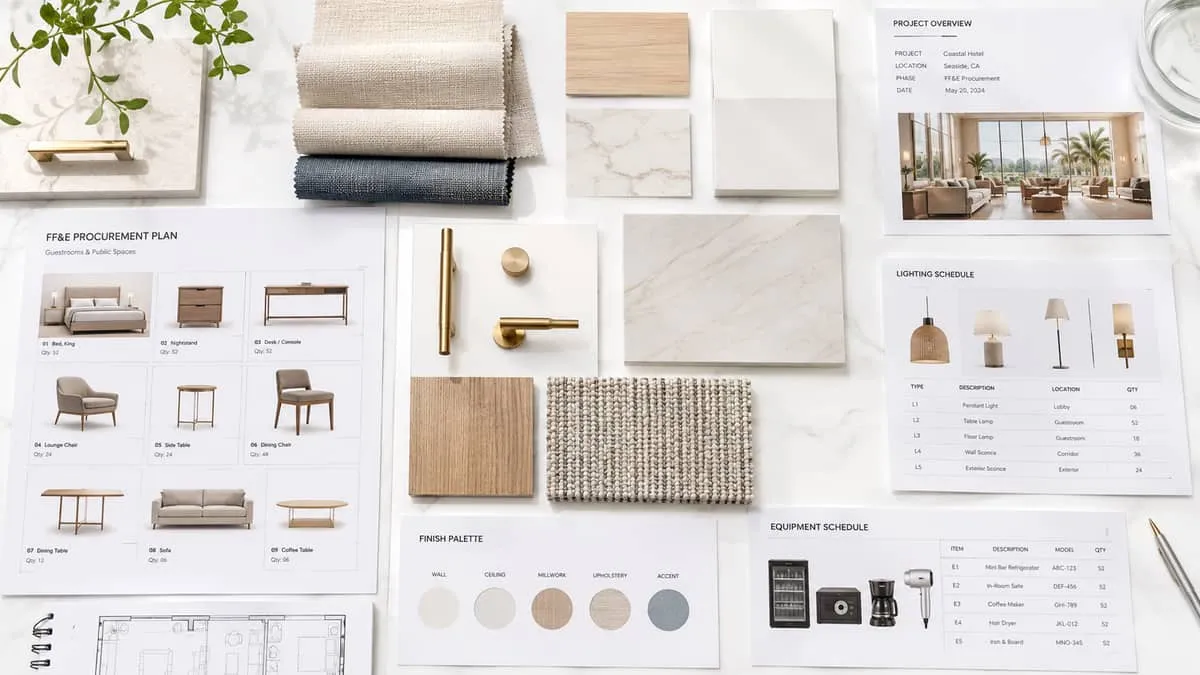
For a new-build or full renovation in Winnipeg's downtown core, the typical FF&E split on a mid-market hotel runs roughly 60 to 70 percent on guest room furniture and case goods, with the remainder divided across public spaces, food and beverage, and lighting. A property like Alt Hotel at True North Square, designed to serve the Canada Life Centre entertainment district and the insurance sector corporate traveller, would concentrate its FF&E spend on guest room durability and lobby experience, with less emphasis on elaborate F&B programming compared to a leisure-driven property.
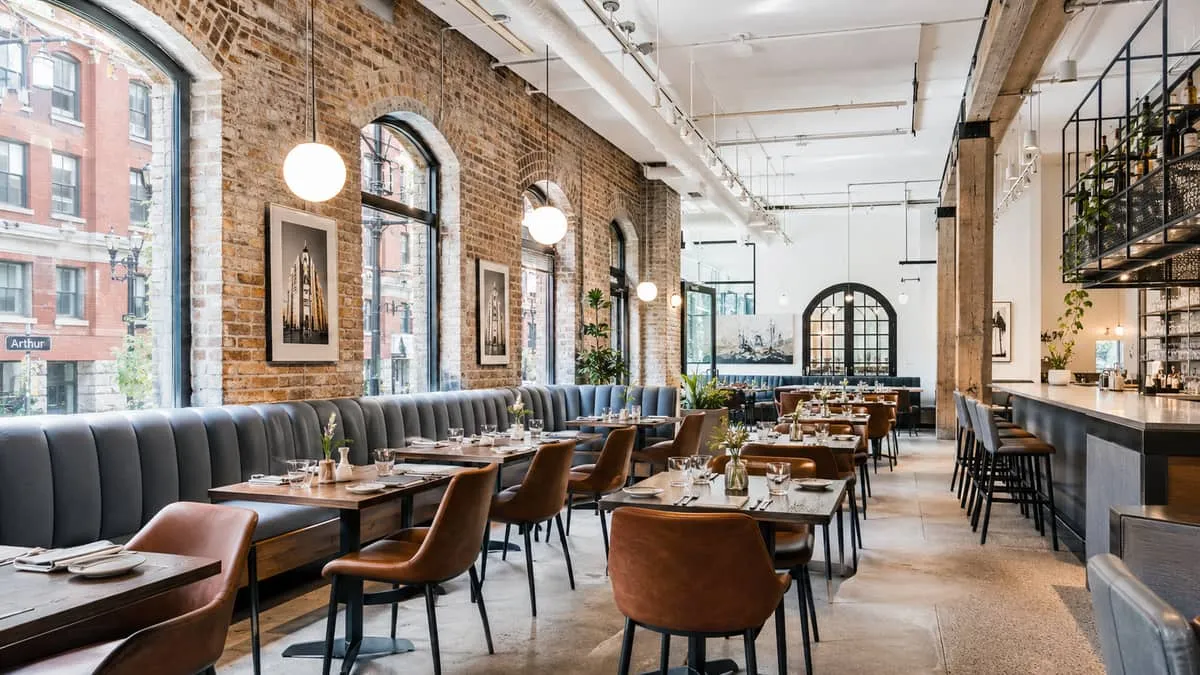
That balance shifts for an Exchange District boutique renovation, where the bar and restaurant often carry as much design weight as the rooms, and the FF&E schedule reflects accordingly.
The Prairie Procurement Problem: No Port, No Distribution Hub
This is the most significant structural difference between running FF&E procurement in Winnipeg versus Vancouver, Montreal, or even Calgary. Winnipeg has no direct container access. Everything imported from overseas, which covers a substantial portion of mid-market contract furniture, arrives by rail or truck after clearing customs in Vancouver or Halifax. That adds cost, adds time, and adds another potential point of delay.
The practical implication: lead times on imported casegoods for a Winnipeg project should be budgeted at six to ten weeks longer than the manufacturer's standard quoted lead time. A factory in Asia quoting twelve weeks to container means eighteen to twenty-two weeks to your Winnipeg receiving dock, accounting for ocean freight, customs clearance, trans-shipment, and final delivery.
Eastern Canadian manufacturers, which supply a large share of the upholstered seating and custom millwork used in hospitality projects across the country, run their own timeline challenges. Custom upholstery orders from Ontario and Quebec manufacturers consistently run sixteen to twenty weeks for contract quantities. If your specification includes custom fabric or a proprietary finish, add another three to four weeks for material sourcing.
The responsible FF&E procurement timeline for a new Winnipeg hotel project needs purchase orders placed no later than seven months before your target opening for anything custom, and six months minimum for stocked contract items. Operators who start procurement conversations after construction is underway, which is extremely common, are almost always looking at a compressed timeline that costs money or compromises specification.
One mitigation that makes genuine sense in this market: identifying which specification items can be sourced from Canadian warehouse stock versus made-to-order. Several contract furniture manufacturers maintain warehouse stock of their core hospitality programs in Toronto or Calgary. For items where the design allows it, specifying a stocked configuration can cut lead time from twenty weeks to three or four.
How Winnipeg's Corporate Account Base Shapes Spec Decisions
Leisure-driven hospitality markets, think Banff or Niagara Falls, specify FF&E around guest experience and Instagram appeal. High-touch textiles, dramatic lighting, feature furniture in lobbies. The business case is emotional.
Winnipeg operates differently. The dominant corporate account base is government and insurance. Great-West Life and Wawanesa together account for a significant share of the city's corporate travel volume, and government departments generate consistent bookings year-round. That client base prioritizes comfort, reliability, and quiet professionalism over design statement.
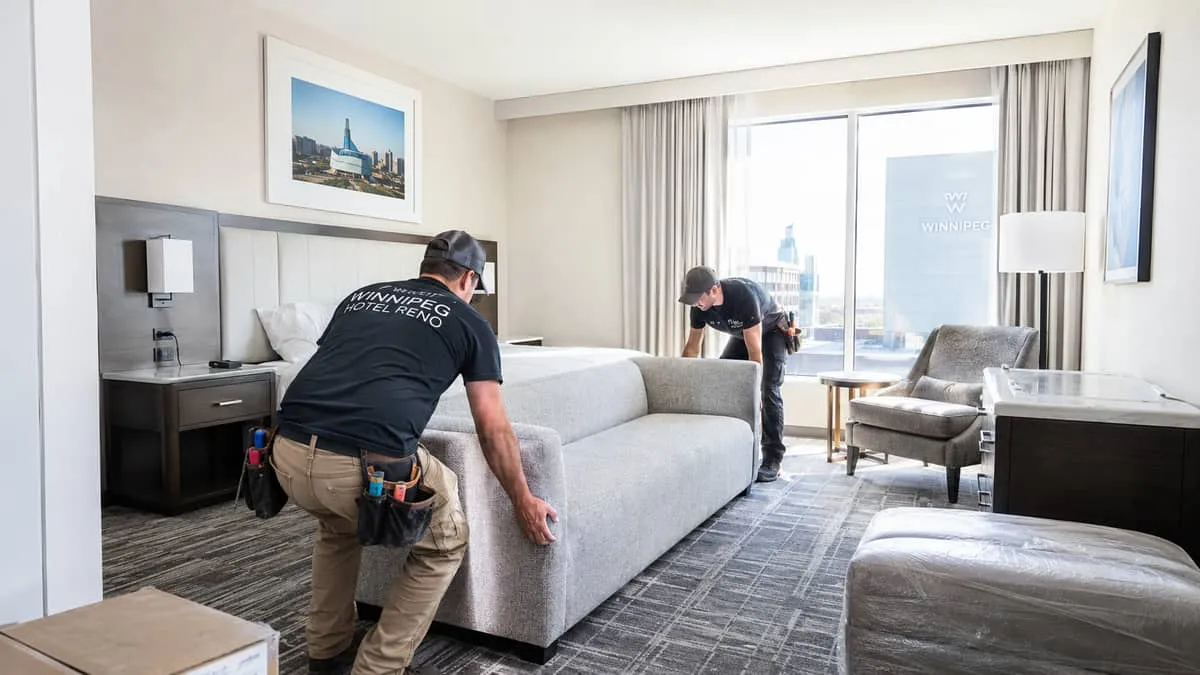
The FF&E implications are concrete. Guest room case goods for a Winnipeg corporate hotel should be specified with commercial-grade laminate or wood veneer construction, not the lower-end furniture-board construction that passes in leisure markets where guests are rarely in their rooms. Drawer hardware should be full-extension with soft-close mechanisms. Desk chairs and task seating need to be genuinely ergonomic, not decorative. The corporate traveller staying five nights a week notices these things in ways a leisure guest does not.
Lobby seating for a corporate-facing Winnipeg property works best as a mix of lounge seating and semi-private work zones. Fabric selection on anything in the lobby or corridor should be specified at a minimum 100,000 double rubs for durability, with preference for performance textiles that resist the salt, moisture, and general wear that comes with a property serving guests through a Winnipeg winter.
The insurance sector also drives some conference and event business, which affects banquet FF&E decisions. Properties near Canada Life Centre or in the downtown core that are competing for insurance industry conferences should specify stackable banquet chairs in a commercial contract grade, not the lightweight chairs that work fine for low-volume meeting programs.
Heritage Buildings in the Exchange District: Procurement Complications
The Exchange District is Winnipeg's most architecturally significant hospitality zone. Operators renovating heritage buildings on McDermot Avenue or Arthur Street are dealing with a specific set of FF&E constraints that don't apply to new-build projects.
Elevator dimensions in heritage buildings frequently limit what can be moved intact. Oversized furniture pieces, king bed frames assembled as a single unit, large sectional sofas, or substantial millwork elements, need to be verified for passage through stairwells and elevator cabs before they're specified. The alternative is specifying furniture designed to be assembled in place, which exists in the contract market but requires a specific search and isn't the default offering from most manufacturers.
Floor load ratings matter in heritage buildings. Cast-iron column construction, which is common in Exchange District commercial buildings, typically handles concentrated loads differently than poured concrete. Before specifying heavy casegoods, stone-topped tables, or large case pieces in an upper-floor application, confirm load capacity with your structural engineer. This is not a step to skip.
Acoustic performance is another Exchange District consideration. Many heritage buildings have concrete floors, exposed brick, and minimal sound isolation between floors. FF&E choices, including area rug placement, upholstered wall panels, and sound-absorbing ceiling elements, carry more acoustic weight in these buildings than in new construction with proper sound isolation built in. Seating with high upholstered backs provides meaningful sound absorption in a restaurant context without requiring architectural intervention.
For operators doing boutique hotel or restaurant projects in Exchange District spaces, sourcing Indigenous art and craft from Winnipeg-based Indigenous artists and makers as part of the FF&E and artwork program has become both a genuine design direction and a visible commitment to the city's cultural identity. This is worth building into the FF&E budget as a line item from the start, rather than treating it as a late-stage add-on.
Installation Logistics in a Continental Climate
Winnipeg's climate is not incidental to FF&E procurement planning. It is a logistics variable that operators in milder cities don't face.

Installation scheduling in Winnipeg needs to account for winter access conditions. Moving furniture through a loading dock or up a freight elevator during a minus-30 cold snap requires extra crew time, protective wrapping for wood finishes and upholstery, and realistic padding on daily installation targets. Cold also affects adhesives and finishing materials used in millwork installation, which is relevant for projects with significant custom built-in elements.
The shoulder seasons, October through November and March through April, carry their own risks. Freeze-thaw cycles create slippery conditions at loading docks and increase the risk of floor damage from tracked-in moisture during move-in. Any high-end hard flooring installed before furniture move-in needs protection.
The practical planning approach: if your target opening is late spring, which is common for properties trying to capture the June-through-August period that represents Winnipeg's most active hospitality season, work backward from an April furniture installation window. That means procurement orders need to be placed in September or October at the latest for standard lead time items, and earlier for anything custom.
For The Forks area restaurants or patio-facing properties, the FF&E scope often includes outdoor furniture for a genuine but short season. June through August in Winnipeg supports outdoor dining, and operators who invest in commercial-grade outdoor furniture rather than residential patio sets will get multiple seasons of use. Specify aluminum or powder-coated steel frames with UV-resistant fabric on any outdoor upholstered pieces. Winnipeg's sun exposure in summer is more intense than operators from milder climates expect.
What FF&E Budgets Look Like in This Market
Budget benchmarks for FF&E procurement in Winnipeg vary by property type and scope. As a planning framework: budget-tier hotel guest rooms typically land in the $3,000 to $6,000 per key range for FF&E alone. Mid-market properties run $7,000 to $14,000 per key. Upper-upscale and boutique properties, including Exchange District heritage conversions with custom millwork and premium finishes, can reach $18,000 to $25,000 per key or higher.
Restaurant projects in Winnipeg's active hospitality zones vary too widely for a simple per-seat benchmark, but a full dining room fit-out for a mid-sized Exchange District or Forks location, covering seating, tables, lighting, and millwork, typically falls between $180,000 and $450,000. Properties targeting the Hotel Fort Garry tier of finish will be at the higher end of that range.
These figures exclude OS&E, soft costs such as designer and procurement agent fees, freight and receiving, and any construction scope. Include them in your pro forma from the first planning meeting, not as a late discovery after construction bids come in.
Winnipeg's cost structure does have a genuine advantage relative to coastal markets. Lower land and construction costs give operators more room in the overall project budget for FF&E quality. Properties here can frequently spec commercial-grade contract furniture that would be value-engineered out of a comparable Toronto or Vancouver project. That's an opportunity, and operators who take it seriously end up with properties that hold up longer and require less frequent renovation cycling.
Working with Procurement Partners in Winnipeg
Most hospitality operators in Winnipeg don't run FF&E procurement in-house, and the True North Square era projects are no exception. The work is typically managed by an interior designer, a dedicated procurement firm, or a combination of both.
An interior designer specifies what gets purchased: the exact model, finish, fabric, and configuration for every item. A procurement agent takes those specifications and handles vendor sourcing, purchase order management, freight coordination, and receiving. For smaller Winnipeg projects, one firm often handles both functions. For larger hotels or multi-property programs, separating the roles gives clearer accountability and often better cost control.
The core deliverable from whichever structure you use is a detailed FF&E schedule: a document that lists every item, its specification, its vendor, its unit cost, its quantity, its lead time, and its current delivery status. This document runs the project. If your procurement partner isn't producing and maintaining one, that's a signal to ask direct questions about how the project is actually being managed.
For a new Winnipeg hotel project in the current development environment, procurement conversations should begin at schematic design or earlier. By the time a project reaches design development, the lead time math is already starting to work against you on anything custom or imported.
If you're planning a hotel or restaurant project in Winnipeg and want to understand where contract furniture sourcing fits into your procurement approach, the guides below are a useful starting point.
Pricing for FF&E in Winnipeg depends on quantities, finishes, and your delivery window, so a project-specific quote beats any list figure. Request a quote to get yours.