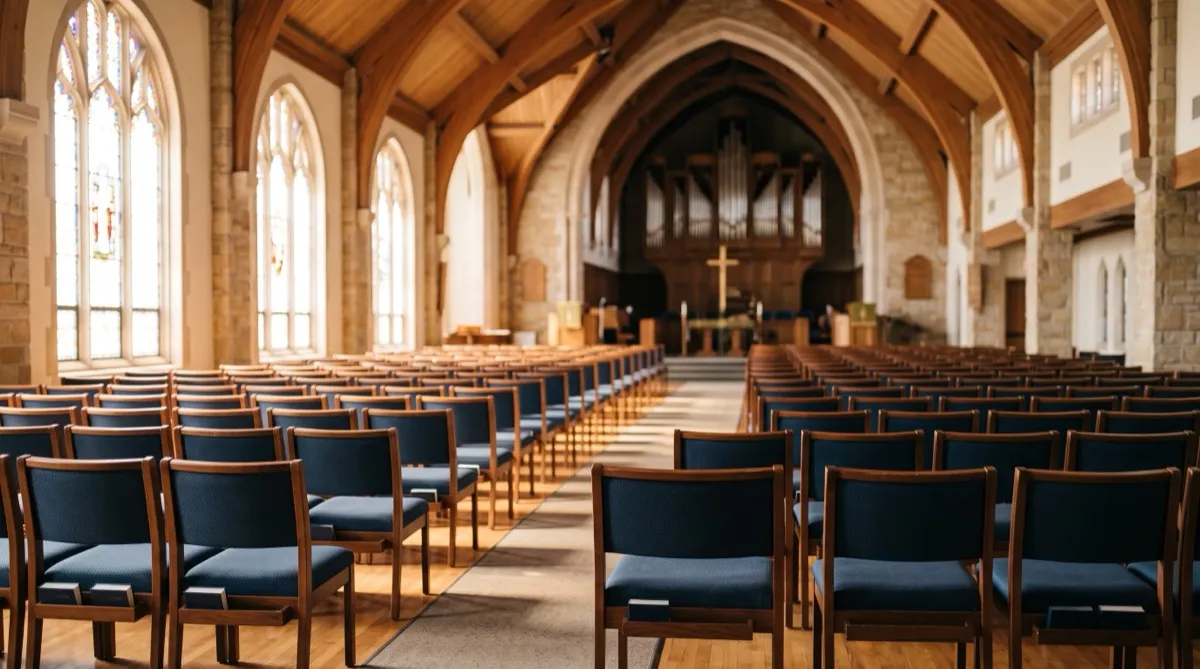
Sanctuary · Chapel · Fellowship · Classrooms
Church Chairs and Church Furniture for Growing Congregations
Plan sanctuary, chapel, fellowship, and classroom seating. A 40 to 300-person program is an illustrative starting brief; confirm the actual layouts, sample terms, supplier proposals, and any phased order.
Tell us your seat count.
Share your seat count, room requirements, and approval dates for relevant independent suppliers to review. Ask each supplier about samples and an itemized proposal. Not sure on the count? Start with the church seating calculator.
Why churches are switching from pews to chairs
Compare pews and chairs against the congregation’s actual worship and event program. Movable seating offers layout choices, while capacity, comfort, accessibility, handling, and storage still need to be checked in the actual room.
Flexibility
Compare worship, wedding, funeral, and concert layouts with the actual staff, chair weights, carts, storage, and reset route. Trial the changeover rather than assuming a reset time or crew size.
Capacity
Compare the actual pew and chair layouts, including row spacing, aisles, accessible seating, and sightlines. Changing to chairs does not establish a capacity increase.
Comfort
Trial the actual seat and back with congregation members for the intended service. Foam density, padding, and a contract label alone do not establish comfort or superiority to a pew.
Phased budgets
Consider phased orders against attendance and the board’s budget. Confirm availability, price, finish acceptance, and reorder terms for each phase rather than assuming later stock will match.
Accessibility
Review wheelchair positions, companion seating, routes, exits, and sightlines in the actual room plan. Removable chairs can support layout choices, but do not by themselves establish accessible seating or permitted capacity.
Read the full case: why churches are replacing pews with chairs and the side-by-side church pews versus chairs comparison.
Chair programs for every room
Use each room’s activities and layout to prepare a separate furniture brief, then compare documented models and supplier proposals.
Program
Sanctuary
Plan the main worship room from the approved layout. The 100 to 300-plus-seat range is an illustrative program size. Confirm actual chair tests, compatible ganging, and any book racks or kneelers for the selected model.
Read the guide →
Program
Chapel
Smaller worship and prayer spaces, weddings, and daily services. A more refined chair often works here, with wood-look frames or upholstered backs to match the room.
Read the guide →
Program
Fellowship hall
Plan dinners, meetings, and overflow layouts with actual chair and table dimensions, approved stack limits, compatible carts, and storage. Trial the staff changeover between events.
Read the guide →
Program
Classrooms
For Sunday school, youth, and adult study, confirm age and task fit, chair weights, approved stacking, table dimensions, and cleaning instructions. Check any nesting requirement against the actual storage space.
Read the guide →
Options to specify
Church chairs are configured, not just bought. These are the choices the committee makes before ordering.
Ganging and interlocking
Ask which connectors are approved for the exact chair and how they are installed. Review the connected rows, access, and circulation in the project layout; a connector does not establish code compliance.
Learn more →
Book racks
Confirm the rack is compatible with the chair and intended hymnals, Bibles, or other items. Check occupied row clearance and cleaning access with the rack installed.
Learn more →
Kneelers
Confirm kneeler compatibility, operation, and clearances for the actual chair and row layout before including them in the order.
Learn more →
Arms or armless
Trial arms and armless models with intended users and the actual row layout. Compare dimensions, entry and exit, support, and quoted prices rather than assuming one option always costs less or fits better.
Learn more →
Stacking and carts
Confirm approved stack limits, compatible dollies, loaded footprints, and the route to storage. Trial clearing the room with the actual staff and equipment.
Learn more →
How many chairs fit your sanctuary?
Enter your room size, row layout, and aisle plan to estimate seat capacity and how many chairs to order, with the math shown.
How buying works for committees
Organize the committee review around sample terms, an itemized proposal, its approval dates, and the supplier’s written production and delivery milestones.
Request sample chairs
Ask each proposed supplier whether samples are offered, at what cost, and on what timetable. Trial the finalists and review finishes in the room before the committee approves a model.
Board-approval quote
Request an itemized proposal with quantities, model identifiers, finishes, freight, services, exclusions, and dates. Use the committee’s actual approval requirements when preparing it for a board or elders vote.
Phased delivery
Ask suppliers to document phased quantities, price, allocation, finish acceptance, and reorder terms. Retain the approved specification and sample; later batches may differ.
Freight to the sanctuary door
Agree the actual receiving scope: truck access, pallets, dock or liftgate, unloading, inside delivery, and placement. Confirm which services and dates the supplier includes for the building and service calendar.
If the committee is still weighing pews and chairs, the pews versus chairs comparison lays out the trade-offs honestly before you decide.
Committee questions
How many church chairs should we order for our sanctuary?
The linked calculator uses planning assumptions, including an 8 to 10 square-foot reference range adjusted for row spacing and 5 percent spares above its row-chair count. These are not a confirmed chair layout or required spare quantity. Enter the actual dimensions and reconcile its displayed plan with approved routes, exits, accessible seating, and existing inventory.
Can we get sample chairs before the committee decides?
Ask the proposed supplier about sample availability, cost, shipping, and return terms. A sample trial can help the committee compare the actual seat, back, handling, and finish before approving the order.
Can you provide a quote formatted for board or elder approval?
Include the committee’s requirements in the inquiry and ask each supplier for an itemized proposal. Confirm models, quantities, finishes, delivery services, exclusions, and dates; the committee decides whether the proposal meets its approval requirements.
Can we buy chairs in phases as our budget allows?
Discuss a phased order with the supplier and confirm availability, pricing, finish acceptance, and reorder terms for each phase. Keep the approved specification and sample, but do not assume future batches will match exactly.
Do you deliver church chairs across the US and Canada?
Provide the destination and receiving conditions when requesting independent supplier proposals. Confirm whether the supplier serves that address, which delivery level is included, and its written milestones. The inquiry does not establish a CFD freight or sanctuary-door delivery service.
Are these chairs strong enough for weekly worship use?
Request the exact model’s intended use, complete-chair test documents, load limits, care instructions, and warranty scope. Trial the chair for the service and staff handling routine; a steel-frame, foam, or commercial label does not establish a lifespan.
Start with your seat count
Ready to seat your sanctuary?
Share your seat count, room program, approval dates, and delivery location for relevant independent suppliers to review. Confirm sample availability, pricing, and the complete receiving scope in their proposals.
Get a chair quote →