
This guide covers the furniture portion of healthcare FF&E for clinics, medical offices, and outpatient facilities. The project can assign exam tables, diagnostic devices, and other clinical equipment to a separate specialist procurement schedule; that does not mean equipment falls outside every healthcare FF&E budget. What counts as FF&E in a healthcare setting is waiting room seating, consult and exam room chairs for patients and visitors, staff break room and admin office furniture, and the tables and casegoods that support those spaces. Keeping that line clear matters at budgeting time, because a healthcare buyer who lumps furniture and equipment into one number ends up with a spec and a quote from two entirely different kinds of suppliers.
What counts as healthcare FF&E, and what doesn't
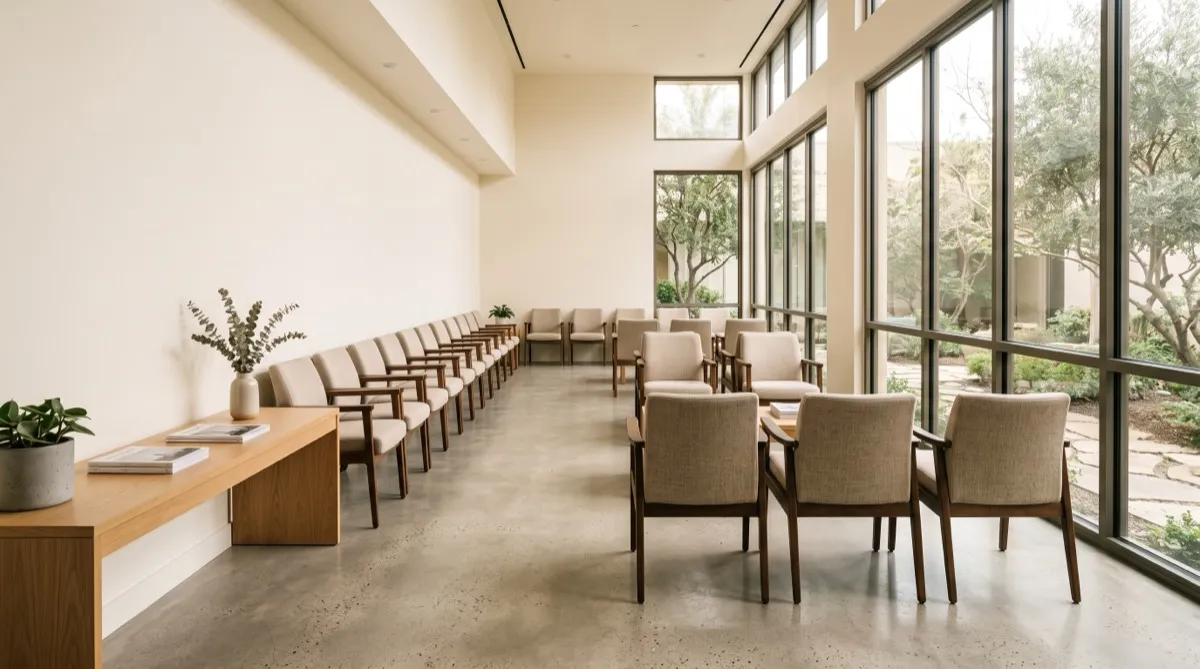
Waiting rooms are the largest and most visible furniture zone in most clinics: seating for patients and visitors, side tables, and often a small reception or check-in counter area. Consult and exam rooms need at least one guest chair, sometimes two, plus a small desk or work surface for the provider depending on the specialty. Staff areas, break rooms, and administrative offices round out the scope; the facility should set their use, cleaning, and exposure requirements rather than assume those rooms are exempt from healthcare-related criteria. The specialist equipment schedule can separately identify items with a clinical function: exam tables, scales, diagnostic carts, and monitoring equipment. A clean specification separates furniture line items from equipment line items from the start, since they run on different lead times, different suppliers, and different budget categories.
What cleanability spec should a clinic actually ask for?
Record the facility's actual between-use cleaning frequency, agents and process before comparing seating; the healthcare label does not establish a higher cleaning rate than every other setting. Select the surface with the facility's infection-control team and the maker's care documents. A vinyl or performance label alone does not establish compatibility with every hospital disinfectant or repeated chemical exposure. The CDC environmental-surface guidance calls for suitable EPA-registered disinfectants used according to instructions; obtain the selected furniture assembly's compatible agents and method before approving it. Have the facility review the exact seams, welting, openings, fasteners and folds with the maker's cleaning procedure on a sample. No seam label alone establishes a sealed surface, fluid resistance or clinical suitability. Ask a supplier directly whether a given chair's upholstery and seam construction is rated for the disinfectant your facility actually uses, since not every vinyl holds up to every cleaning chemical the same way.
ADA clearances in a healthcare setting
Have the architect and project team establish the accessibility requirements for the actual facility, seating positions, reception transaction surfaces and routes. Review exact counter drawings, approaches, clearances and occupied seating rather than assume an extra low counter or movable chair establishes compliance. Ask suppliers for the relevant product drawings; code applicability and approval need the project documents and responsible reviewers.
Bariatric seating ratios
Ask the facility's qualified team to define the patient accommodation needs, including any higher-load or wider seating, and its positions in the room. Obtain the exact assembly's intended-use limit, seat dimensions and test basis; a bariatric label, reinforced appearance or wider cushion does not establish a capacity or a universal ratio. Check the occupied layout and support requirements before approving models.
Consult rooms and staff areas
Have the facility define actual patient-contact, traffic and care requirements separately for each consult and exam room. A single guest chair is an illustrative layout option, not a universal spec; verify fit, occupied access and the complete model's approved care. For staff break rooms and administrative offices, have the facility identify the cleaning frequency, shared-user needs, and any clinical or infection-control requirements before selecting furniture. Staff-only access does not by itself establish a different care standard. Treating staff space as an afterthought is a common mistake. Break room furniture that has not been replaced in years reads as a real workplace issue to staff even when the clinical spaces up front look sharp.
Multi-site healthcare systems and standardization
A healthcare system operating multiple clinic locations has the same reason to standardize FF&E specs as any multi-location operator: a repeatable item and documentation schedule. Confirm model continuity, approved substitutions, parts and dated quantity proposals; neither standardization nor network size guarantees fast reorders, consistent patient experience or inaccessible-to-others prices. Use the Commercial Furniture Lead-Time Index to plan order dates against a clinic opening or renovation schedule, since healthcare buildouts often run on a fixed regulatory inspection date that furniture delivery cannot be late for. For the full specification and ordering process, see our FF&E spec sheets guide, and for how FF&E differs from what a landlord or general contractor typically provides in a medical office buildout, see FF&E versus OSE.
Ordering healthcare furniture
Once your waiting room, consult room, and staff furniture spec is locked, including your bariatric seating ratio and vinyl or performance upholstery choice, browse side chair concepts and request a quote with the room counts, exact dimension and load requirements, approved cleaning criteria, and target dates. Ask responding suppliers for model-specific documentation and have the facility review it; the category is not evidence of clinical approval. For the broader procurement sequence from specification through installation, our FF&E procurement process covers the full workflow.