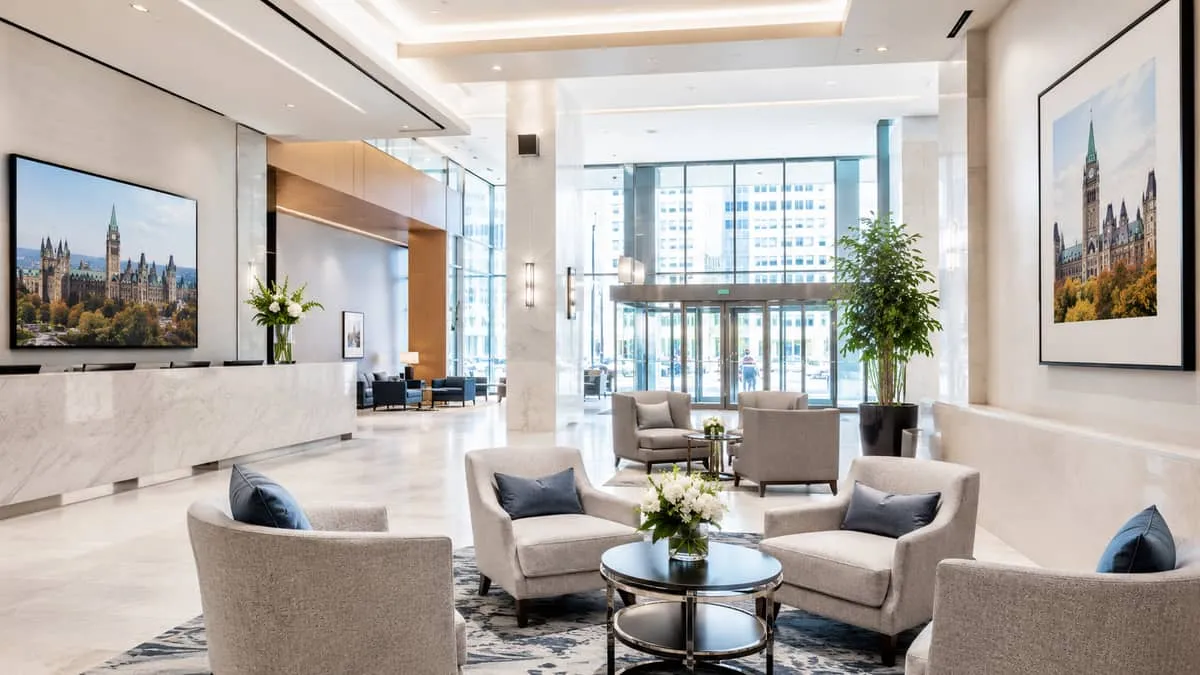
Ottawa hotels operate in a market unlike any other in Canada. On any given weekday morning, the lobby of a property near Parliament Hill might host a federal minister reviewing talking points before a scrum, a senior diplomat from an embassy on Sussex Drive, and a convention group arriving for a national association conference, all within the same thirty-minute window. The lobby is not a waiting room. It is a working room. And in a city where professional credibility is currency, the furniture in that lobby carries real weight.
If you are sourcing hotel lobby furniture Ottawa properties need for this kind of clientele, you are not choosing between durability and presentation. You are choosing pieces that deliver both, because the guests you serve will notice when either is missing.
The Political Hotel Standard: What Lobby Furniture Communicates Near Parliament Hill
Properties along the Rideau Street corridor and in Centretown, within walking distance of Parliament Hill and the Langevin Block, serve a guest profile that is acutely environment-aware. Federal ministers, deputy ministers, lobbyists from Sparks Street firms, and delegations from foreign missions are all practiced observers of professional staging. They spend their working lives in rooms where every detail is deliberate. They bring that same attention to your lobby.
The furniture standard these guests expect is not flashy. It is composed, serious, and quietly durable. Oversized statement pieces or aggressively contemporary silhouettes read as insecure in this context, as though the property is trying to impress rather than serve. What works is low-profile lounge seating with clean lines, solid frame construction with no visible flex, upholstery in neutral commercial-grade fabrics that hold their appearance under sustained use, and side tables proportioned for working documents and a coffee cup rather than decorative objects.
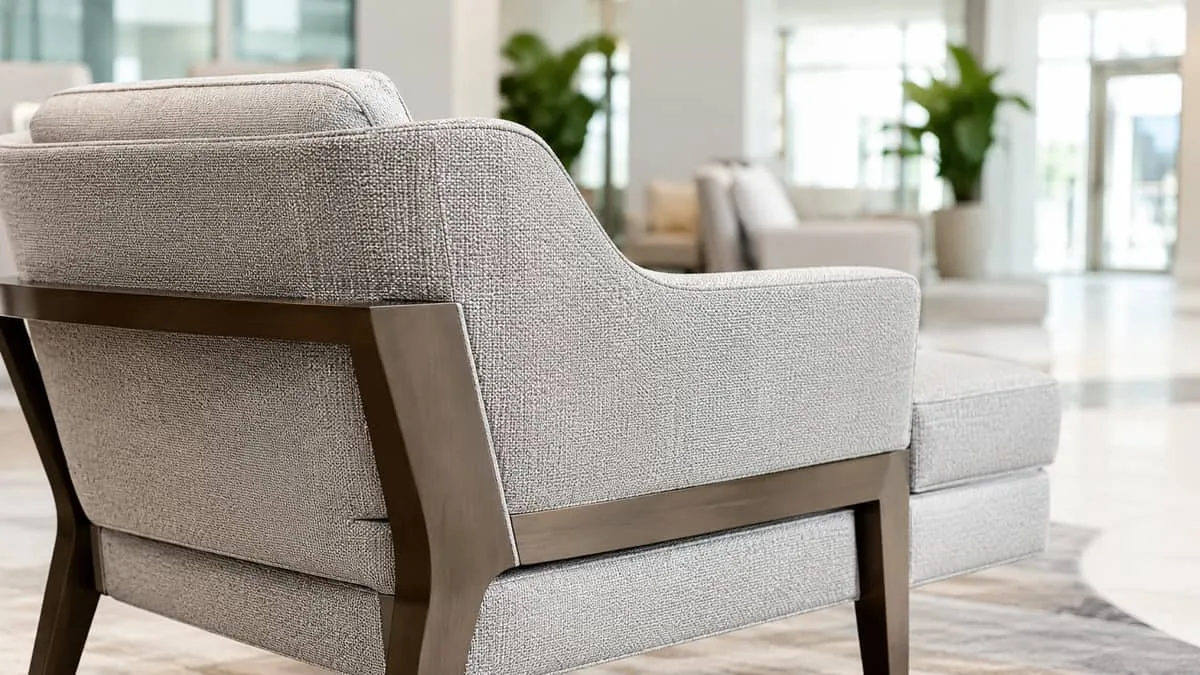
Kiln-dried hardwood frames or welded steel, high-density foam rated for commercial rotation, and upholstery fabrics tested to at least 50,000 double rubs on the Wyzenbeek scale are not premium specifications for this market. They are baseline requirements. A chair that softens or sags within a year of installation in a government-adjacent property will not survive the replacement cycle and will register as neglect to the exact guests whose repeat bookings matter most.
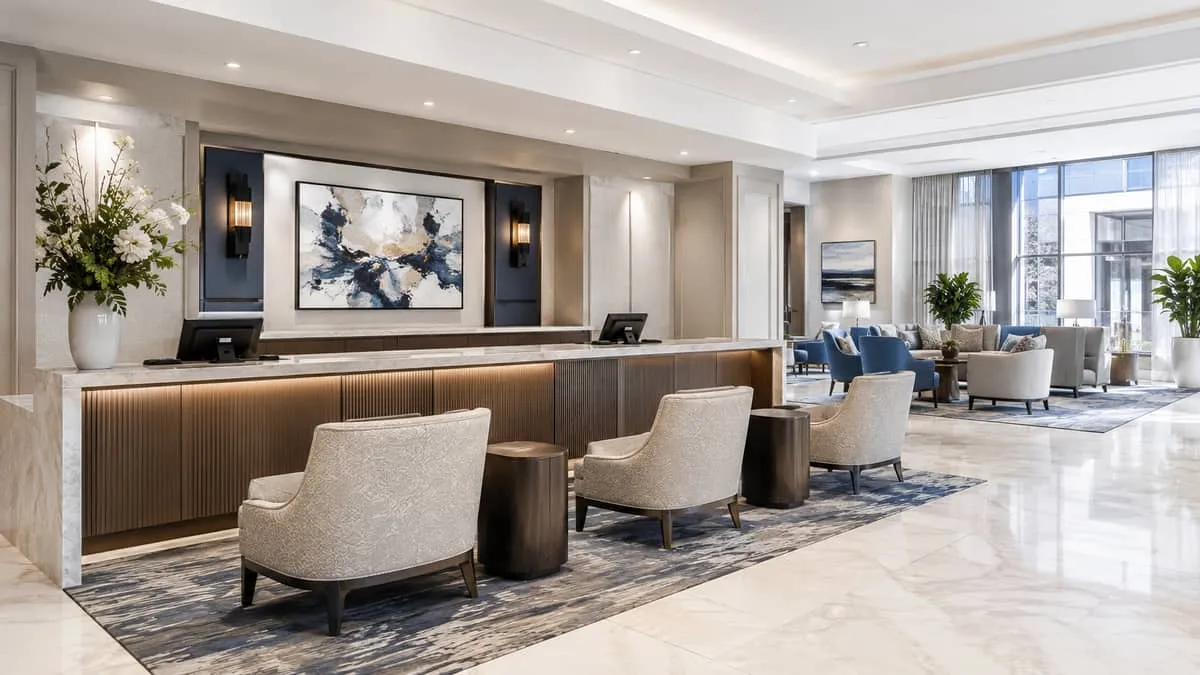
Reception area seating in front of your front desk sets the tone for the entire common area. If those chairs are well-proportioned and properly finished, guests assume the property behind them matches. If they are worn or visually mismatched with the lounge seating eight feet away, the dissonance lands even when guests cannot name it.
The Chateau Laurier Benchmark and What It Means for Every Ottawa Property
The Fairmont Chateau Laurier has set the physical standard for Ottawa lobby design since 1912. Its stone arches, vaulted ceilings, and heavily upholstered seating in deep, authoritative tones have established a reference point that every other property in the capital competes against, consciously or not. Guests who have sat in the Chateau's lobby arrive at your property with that benchmark already in their heads.
You are not expected to replicate a century-old landmark. But you are expected to demonstrate the same underlying understanding: that lobby furniture in this city is a professional statement, not a decorative afterthought. The Chateau earns its standard through scale and heritage. Other properties earn it through deliberate specification and consistent maintenance.
What the Chateau Laurier teaches the Ottawa market practically is that dark finishes on legs and bases hold better than natural wood in high-traffic lobbies. That upholstery in mid-tone neutrals with textural depth holds its appearance longer than flat-weave light fabrics. That the mass and proportion of a piece signal quality faster than surface ornamentation does. These principles translate to contract procurement at any price point, and they are especially relevant in Ottawa, where the guest audience is more experienced and harder to impress than in leisure-dominated markets.
Properties near the Shaw Centre and along Colonel By Drive that want to compete for government and diplomatic travel accounts need furniture that holds up to this contextual standard even at volume. That means investing in specification rather than counting units.
Convention Traffic from the Shaw Centre: Furniture Under Sustained Pressure
The Shaw Centre is the largest convention facility in the Ottawa region and draws national and international association conferences throughout the year. Properties along Colonel By Drive, in the Centretown corridor, and near the Rideau Centre absorb large delegate volumes when major events run. When a conference breaks and several hundred people move through hotel lobbies at once, the wear pattern on furniture changes completely compared to transient or leisure traffic.
Seating clusters near power access get used constantly and hard. Tables in corridor traffic paths accumulate edge scuffs within a single conference season. Any chair with a light or natural finish on the legs shows impact marks before the event group has even checked out.
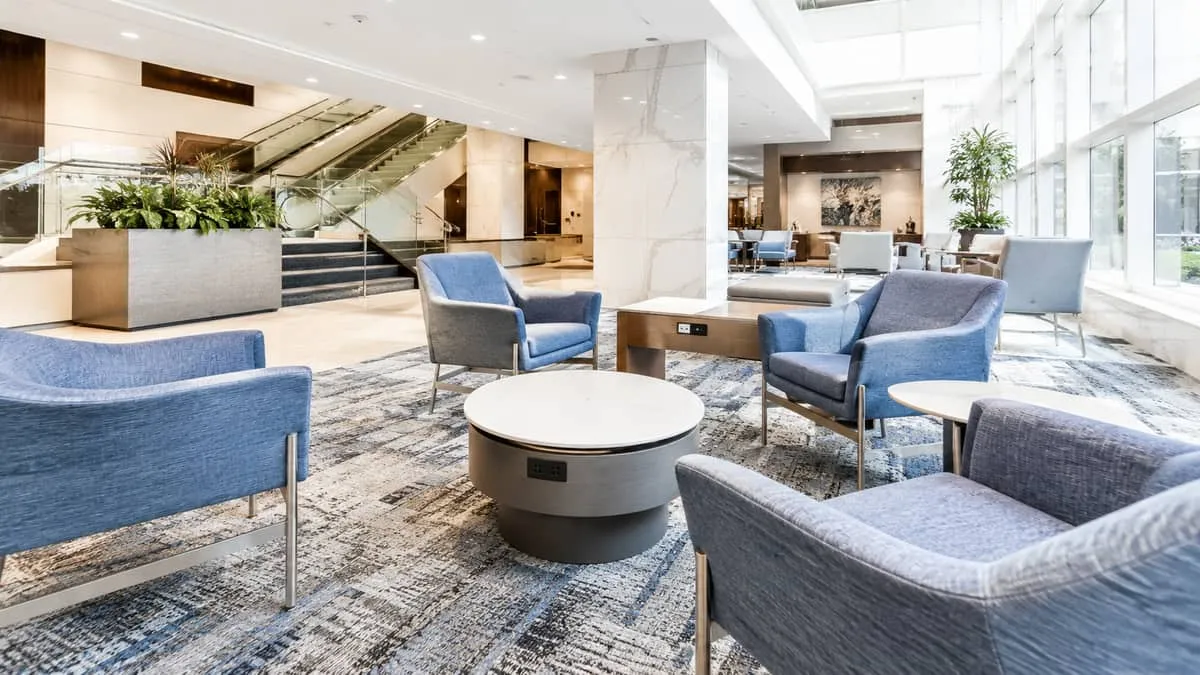
For properties that serve this market on a regular schedule, the specification standard is specific. Metal bases or powder-coated steel legs rather than natural hardwood. Table surfaces in laminate, stone composite, or high-pressure laminate rather than veneer. Upholstery in performance fabrics that clean under standard commercial protocols and resist the kind of ballpoint pen and coffee cup contact that convention delegates generate at a rate leisure guests do not.
The other practical consideration is cleaning access. Contract furniture specified for a convention-adjacent lobby needs to be maintainable at the end of a long event day, not just photogenic when newly installed. Ask your supplier for the manufacturer's cleaning and maintenance documentation before you sign a purchase order. A supplier who cannot produce that documentation is not a serious contract partner for a high-volume Ottawa property.
ByWard Market and the Boutique Hotel Problem
The hotels near ByWard Market operate in a different register entirely. The district's mix of independent restaurants, galleries, and pedestrian traffic draws leisure guests who are benchmarking their stay against boutique properties in Montreal's Mile End or Toronto's Ossington corridor. The pressure here is aesthetic and experiential rather than professional and institutional.
For ByWard properties, hotel lobby furniture Ottawa buyers source needs to balance visual range with practical resilience. Modular seating configurations perform well in this context because they allow staff to shift the lobby layout quickly, from a relaxed lounge arrangement during slower periods to a more structured grouping when a private event occupies the common area.
Upholstered benches with removable cushion covers, chairs in warmer neutral tones with contrast piping or textured fabric, and low side tables with surfaces that do not show watermarks from condensation are practical choices for this corridor. The visual register of the pieces should feel current without leaning on trends that date in two or three years. Ottawa hospitality operators tend to run longer furniture replacement cycles than markets like Vancouver or Toronto. Longevity in the design matters as much as durability in the construction.
The boutique ByWard lobby can take more visual risk than a government-adjacent property, with more expressive silhouettes or stronger accent colours, but that risk needs to be grounded in commercial-grade construction underneath. A visually interesting chair that deteriorates within eighteen months is worse than a conservative piece that holds its appearance for five years. Your guests will accept the latter. They will write about the former.
Hintonburg and the Tech Clientele Lobby
Hintonburg represents a separate category in the Ottawa hotel furniture conversation. The neighbourhood's identity as the home base of the Ottawa tech corridor, with proximity to the March Road tech cluster and a dense population of Shopify employees and startup founders, produces a lobby guest profile that is younger, more design-literate, and more likely to use the lobby as an extended workspace than the government or convention traveller.
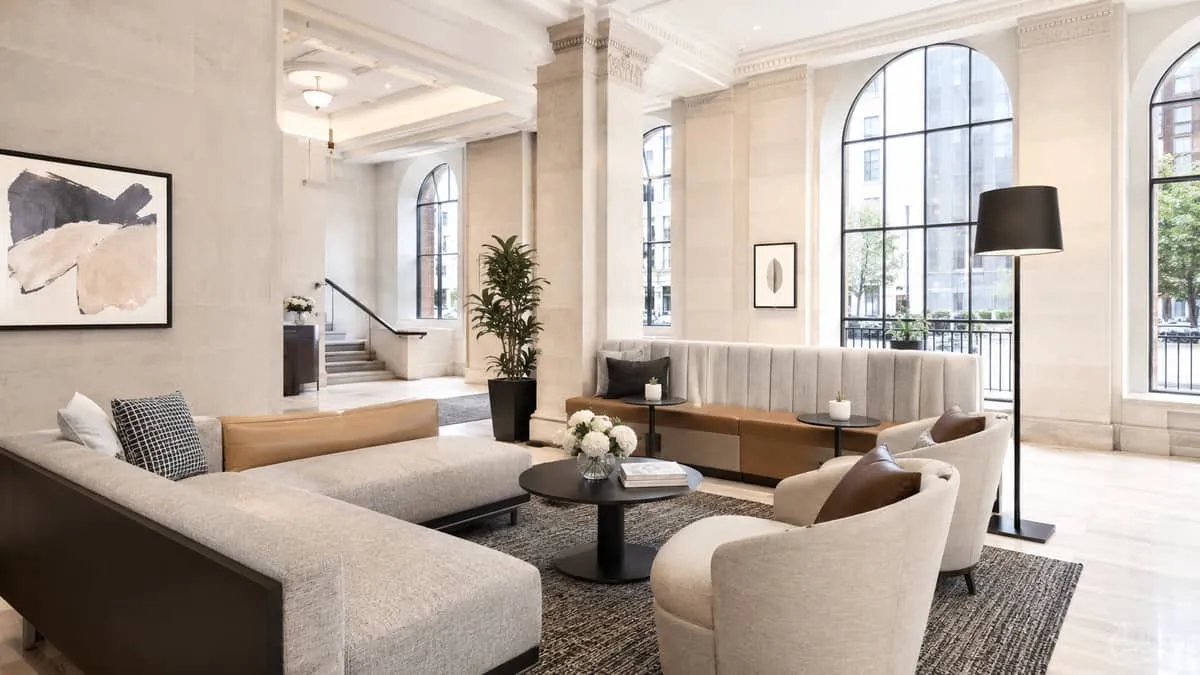
A property serving this clientele needs lobby furniture that functions as a genuine co-working environment, not just a transitional space. That means seating at multiple heights, with proper back support for extended sessions. It means table surfaces sized for laptops rather than just coffee cups. It means power access integrated into seating clusters without visible cord management problems. It means upholstery and materials that feel contemporary and considered rather than institutionally neutral.
The Hintonburg lobby is not trying to signal gravitas. It is trying to signal that the property understands how its guests actually live and work. The furniture choices that accomplish that are different from what you would specify for a Rideau Street property serving ministerial accounts, and a good contract furniture supplier for the Ottawa market will understand that distinction without needing it explained.
Modular pieces with reconfigurable elements, tables on casters for easy repositioning, and seating in materials that allow casual use without looking casual are the practical specifications here. The durability standard does not change, but the aesthetic register and functional priority shift substantially.
Matching Specification to Guest Profile Across the Ottawa Market
Ottawa's hotel market spans budget properties near the Macdonald-Cartier Airport corridor to the Chateau Laurier and Hotel Arts Helix at the upper end of the market. The furniture in your lobby needs to align with the brand promise guests arrive with in their minds, and those promises vary significantly across the city.
A property marketing to federal government travel accounts, where the guest relations office at a department handles booking and the guest is accountable for how public funds appear to be spent, needs seating that reads as professional, composed, and appropriate. There is no upside in that context to bold design choices. The upside is in durability and consistency, so that the property earns a reputation for reliability rather than novelty.
A boutique property targeting leisure tourists visiting Parliament Hill, the national museums on Sussex Drive, and the Rideau Canal cycling circuit can take more visual risk. Stronger colour, more expressive pattern, furniture silhouettes with regional material references are all viable where the guest is choosing discretionary travel and buying an experience rather than fulfilling a government travel policy.
Properties serving the Gatineau cross-river market face a bilingual audience and a design expectation shaped partly by Quebec aesthetic preferences, which tend toward bolder colour choices and more expressive material combinations than the Ontario hospitality mainstream. That is a real consideration when specifying lobby furniture for properties that draw significantly from the Quebec government market or from Gatineau-based federal employees.
Procurement Timeline and Lead Times in the Ottawa Market
Ottawa properties often face compressed renovation windows. The conference season runs from September through June with peaks in the fall and late winter, and major lobby renovations typically need to be completed in the summer window between July and late August. That is a short runway, and it collides with the same peak demand period that other Canadian hospitality buyers are also trying to hit.
Contract-grade furniture lead times on custom or semi-custom pieces run eight to sixteen weeks from order confirmation under normal production conditions. If you are planning a lobby renovation that needs to be complete before Labour Day, your purchase orders need to be placed no later than early May. Waiting until June because you are still evaluating options will push you into a next-year renovation on the pieces that matter most.
Work with suppliers who have current stock in contract-grade pieces for common lobby applications, and confirm production slots in writing for anything that requires a lead time. The Ottawa market does not offer the same renovation flexibility as leisure markets with softer seasonality. Planning your procurement timeline before you start comparing catalogues is not optional here. It is the difference between a lobby that is ready for the fall conference season and one that is still waiting on a container from overseas while your first major group checks in.
National Capital Commission properties and government-adjacent venues face additional procurement constraints around supplier qualification and sometimes require compliance documentation that standard residential or commercial furniture suppliers are not set up to provide. If your property falls into that category, confirm that your furniture supplier has the documentation and procurement history to satisfy those requirements before you invest time in their catalogue.
Every Ottawa venue has its own volume, layout, and turnaround demands, and hotel lobby furniture pricing follows from those specifics. Request a quote and we will scope it to your project.