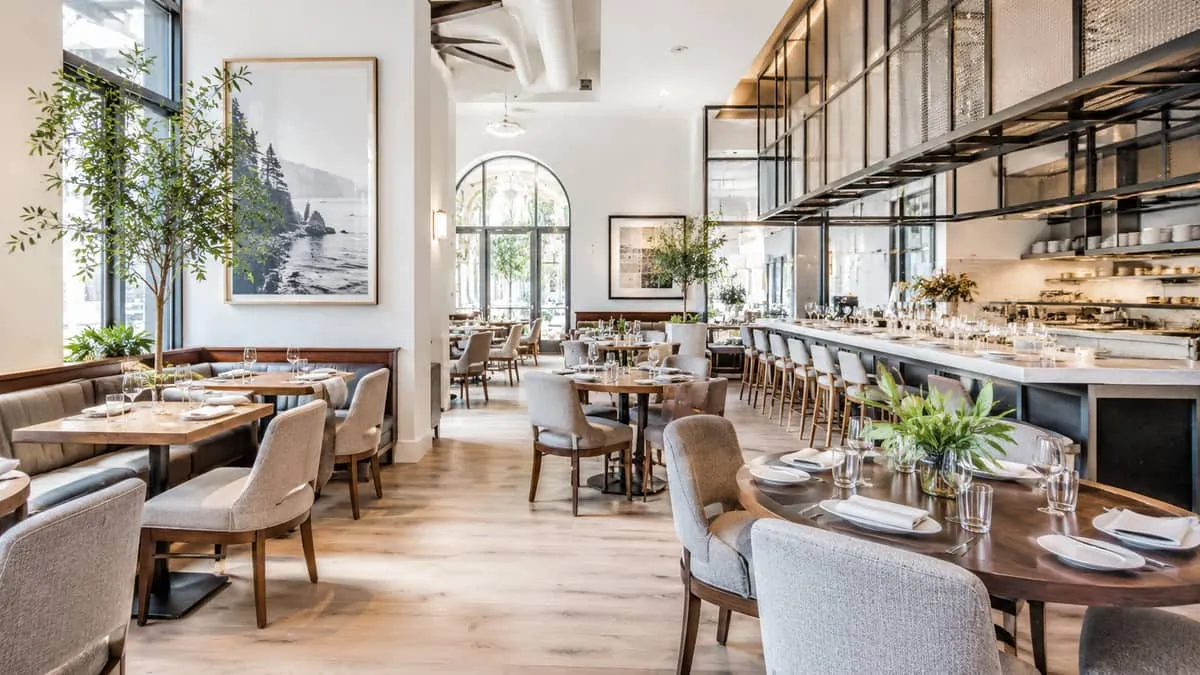
Vancouver does not let restaurants slide by on mediocre interiors. You are operating in a city where the Fairmont Pacific Rim has redefined waterfront hospitality, where Yaletown has become a design destination in its own right, and where Asia-Pacific visitors , arriving from Tokyo, Hong Kong, and Singapore , carry calibrated expectations from some of the world's most refined dining cultures. Film industry money circulates through the city year-round, funding expense account dinners where atmosphere is part of the pitch. In that context, furniture is not a line item to be minimized. It is a signal of what kind of room you are running. Getting restaurant furniture Vancouver right means sourcing pieces built for punishing commercial use that also hold their own against a dining public that notices everything.
The Bar Vancouver Diners Have Set , and What That Means for Your Interior
The competitive pressure on Vancouver's dining scene is unusual among Canadian cities. Celebrity chefs have opened, closed, and reinvented concepts in Gastown and South Granville at a pace that keeps design standards in constant motion. The result is a dining public that is genuinely design-literate. Your chairs will be noticed. Your banquettes will be photographed. And if your furniture reads as an afterthought , wobbly tables, pilling upholstery, bases that scratch hardwood floors , your room communicates the wrong thing about the kitchen.
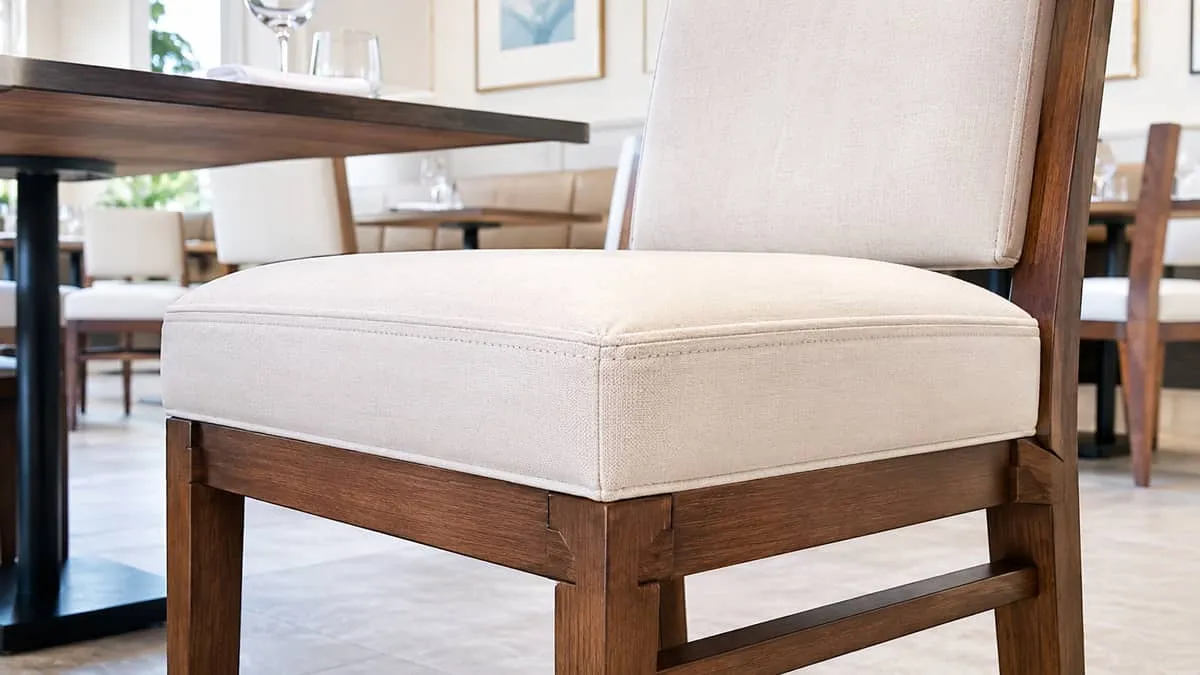
Contract-grade furniture is rated for commercial loads: 250 pounds minimum per seat, frames built to withstand hundreds of thousands of use cycles. Retail furniture, even premium retail, is not built for the turn times a Gastown dinner spot or a Robson Street high-volume operator runs. Joints fail in months. Foam compresses and never recovers. Upholstery threads pull at seams from the friction of guests sliding in and out across a four-hour service. The math on replacement costs alone makes contract-grade the correct decision , but in Vancouver's market, the aesthetic argument is equally compelling. Contract-grade manufacturers who serve the hospitality sector build to look correct at the end of a two-year run, not just at the opening night photo shoot.
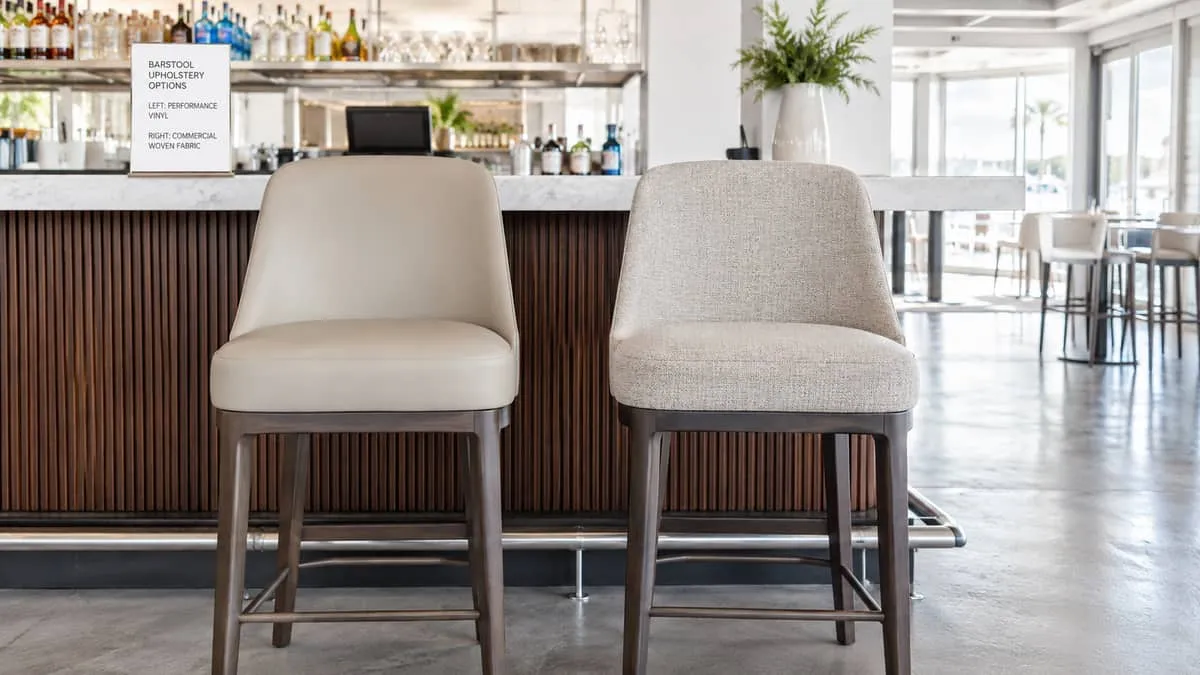
The minimum upholstery specification for a busy Vancouver restaurant is a 50,000 double-rub Wyzenbeek rating. For bar stools, patio seating, or any high-turnover application, push that to 100,000 double-rubs or specify a coated performance fabric with stain-resistant treatment.
Coal Harbour and the Waterfront Specification Problem
Vancouver's Coal Harbour waterfront corridor presents a specific design-and-durability challenge that inland restaurant designers sometimes underestimate. The Seawall draws foot traffic that generates ambient humidity, salt air, and seasonal damp that affects covered patios and semi-open dining rooms differently than a fully enclosed interior. Restaurants with views of the inlet and the North Shore mountains , some of the most valuable real estate in Canadian hospitality , need furniture that photographs beautifully against that backdrop and survives the microclimate.
For waterfront-adjacent seating, marine-grade aluminum frames are the correct outdoor specification. They resist corrosion where powder-coated steel eventually fails, and they hold their finish through Vancouver's wet shoulder seasons without the maintenance burden of teak or FSC-certified hardwood. Sling seating and textilene mesh perform well in environments where standing water is a risk , they drain, dry quickly, and don't harbor mildew the way foam-cushioned patio pieces do when covers are left off.
Indoor seating in a Coal Harbour room with floor-to-ceiling glass needs to manage the visual weight of the exterior view. Low-profile upholstered chairs in warm neutrals , cognac leathers, caramel bouclés, deep charcoal wovens , anchor the interior without competing with the view. Heavy dark wood tables with waterfall edges read as intentional and substantial against the light-filled glass. If your supplier is not thinking about how your furniture reads in relation to your most dominant design element, they are not thinking about your room.
Yaletown: Design-Forward Dining and the Aesthetic Stakes
Yaletown is the neighbourhood where Vancouver's design and hospitality industries overlap most visibly. The converted warehouse buildings, exposed brick, and high ceilings create an interior architecture that demands furniture with a specific character , warm, artisanal, not corporate. Operators who open in Yaletown are competing against rooms that have been photographed and published in national food media. The design standard is high and visible.
The dominant aesthetic in successful Yaletown dining rooms pulls from a vocabulary that blends Pacific Northwest materiality , natural wood, leather, aged metals , with an Asia-Pacific minimalism that avoids clutter and excess. Stacked chairs in the same colour as every other casual restaurant in the city will read as generic immediately. What works: channel-tufted banquettes in a deep forest or navy woven textile, paired with a natural walnut table edge and matte black hairpin or sawhorse legs. Individual dining chairs that borrow from mid-century Scandinavian forms but are upholstered in a performance velvet rather than fabric. Bar stools with solid wood seats and blackened steel footrests.
The spec behind those aesthetics still has to be commercial. A channel-tufted banquette in a Yaletown restaurant is being sat in and stood up from by guests who have had cocktails, who are wearing coats, who are leaning over the table. The COM fabric needs to meet hospitality ratings. The banquette frame needs to be kiln-dried hardwood with corner-blocked joinery, not particleboard. The seat foam needs to be high-resiliency commercial density that returns to shape after every use. Good design and correct specification are not in tension , they are the same job.
Robson Street Volume: Durability at Scale
High-volume operators on Robson Street and in the broader West End are solving a different problem. The goal is not a photographable fine dining room , it is a machine that moves covers efficiently, cleans fast, and maintains its look through a relentless rotation of guests from opening to last call. Tourist traffic, pre-theater dining, and international visitors create a guest mix that puts hard use on furniture across every service.
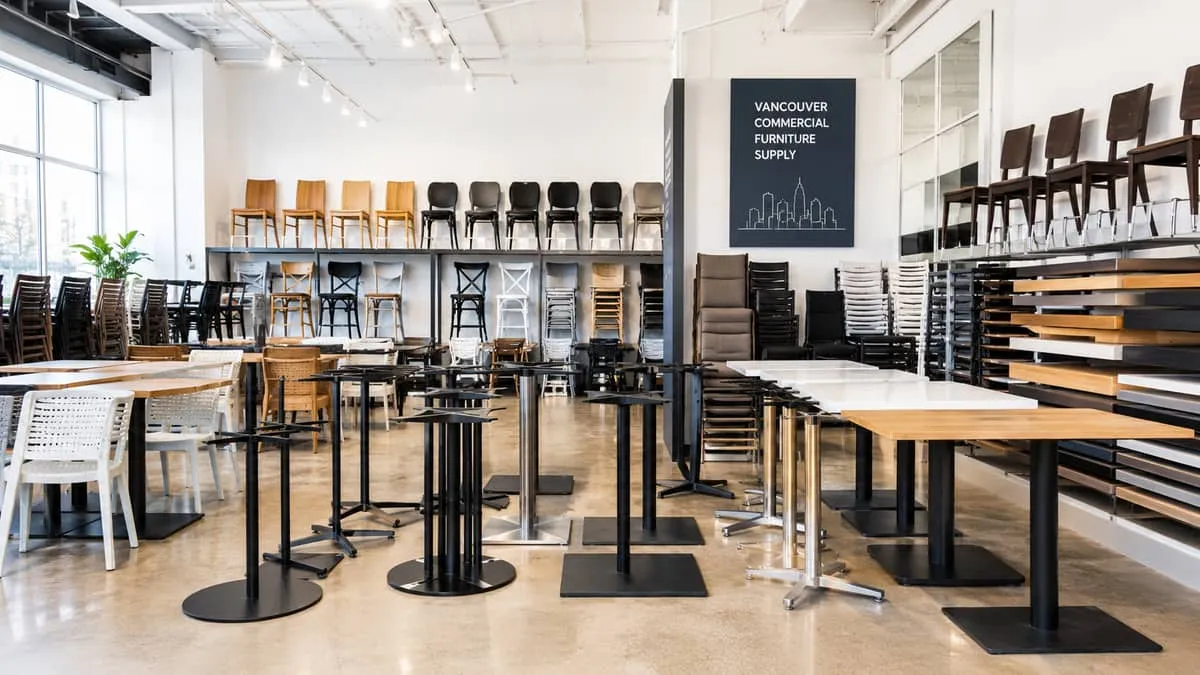
For high-volume applications, stackable chairs are a practical necessity. A solid aluminum or glass-fiber reinforced nylon side chair that stacks eight-to-ten units high is not a concession to pragmatism over aesthetics , well-designed stackable chairs have a clean, resolved look that works in contemporary casual rooms. The key spec is a glide system on the base that stacks cleanly without scratching the chair below and that does not mark hardwood or tile floors.
Table bases for high-volume operators should be weighted cast iron pedestals on commercial-grade casters or fixed feet, depending on your floor surface. Spider bases and four-leg commercial bistro tables handle the constant repositioning that open-floor-plan rooms require when moving covers between singles, deuces, and four-tops. A supplier who only sells you fixed tables for a mixed-traffic Robson Street room has not thought through your operation.
Outdoor Patio Culture Is a Serious Capital Investment Here
Vancouver has the mildest climate of any major Canadian city, and the restaurant industry has built its business model around that fact. Patios open earlier, run longer, and carry more revenue per square foot than most outdoor dining programs in the country. A Gastown patio with heaters and a retractable canopy is not a seasonal bonus , it is a year-round revenue centre that justifies serious furniture investment.
That investment has specific requirements. Outdoor furniture in Vancouver needs to handle the October-through-April rainy season without degrading , which means aluminum or marine-grade stainless frames, not powder-coated steel that begins to rust at screw points and seams within two seasons. Seat cushion materials need to be quick-dry foam with removable, machine-washable or hose-down covers. Resin wicker over aluminum frames has improved dramatically in quality and holds up well in Vancouver's wet climate; the key is a UV-stabilized resin that doesn't fade or become brittle in the summer UV load when the city gets prolonged sun.
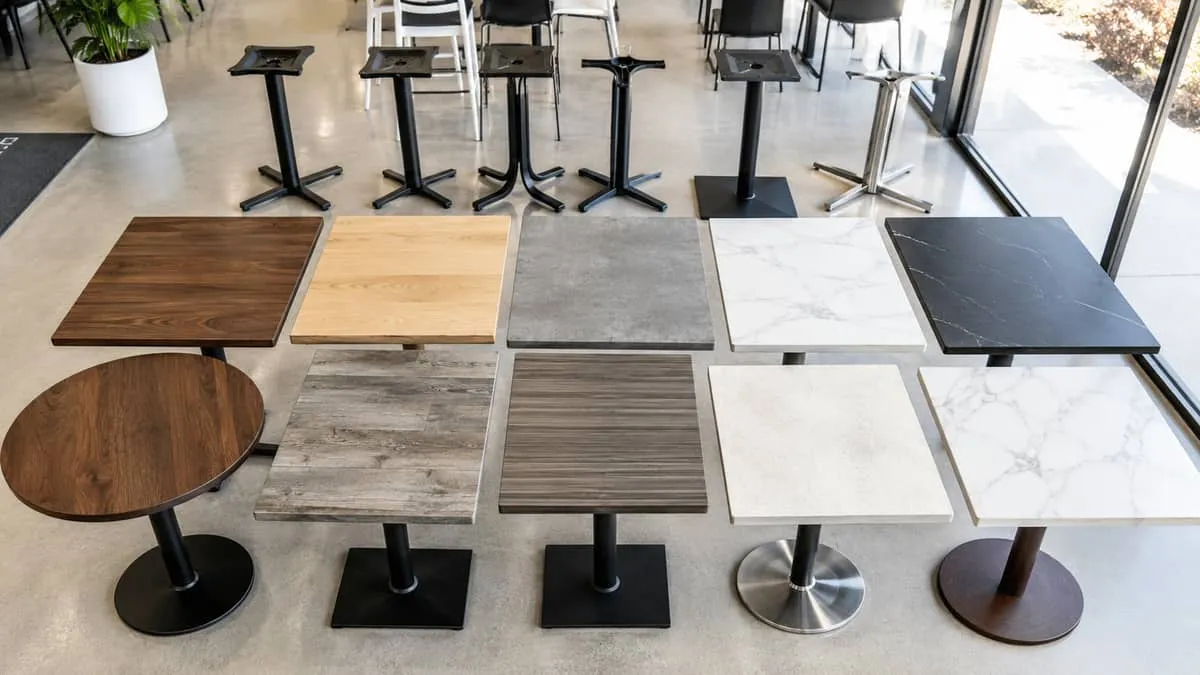
Outdoor table tops for Vancouver patios perform best in HPL (high-pressure laminate), compact laminate, or porcelain. Solid wood outdoor tables require regular oiling and refinishing that most restaurant operations cannot consistently manage. Teak is the exception , it is genuinely low-maintenance outdoors , but the cost premium and sourcing responsibility requirements are real. Porcelain tops on aluminum frames are increasingly the correct specification for a high-end waterfront patio that needs to look sharp over five or more years without refinishing.
Umbrella bases and cantilever umbrellas need to be weighted for the occasional Pacific storm that moves through even in the warmest months. A lightweight umbrella base that tips in a summer squall damages furniture and injures guests. Commercial umbrella systems rated for the coast are a different category from what you find at garden retailers.
Boutique Hotel Restaurants and the Asia-Pacific Expectation
Vancouver's position as Canada's primary gateway to Asia-Pacific markets , in trade, tourism, and immigration , creates a guest profile that is worth understanding in detail if you are operating a hotel restaurant or a high-end dining room. Guests arriving from Hong Kong, Shanghai, Tokyo, or Singapore have typically dined in world-class hospitality environments where every detail is considered. They will notice cheap joinery. They will notice upholstery that has started to pill. They will notice table tops that have been scraped and re-waxed rather than replaced.
Boutique hotel properties in Gastown , the 21c, independent properties on Water Street , operate against this expectation. Their restaurants need furniture that meets an international standard while also communicating a sense of place. Pacific Northwest materials interpreted through a refined lens: white oak with a wire-brushed finish, aged brass hardware, leather in cognac or black with visible stitching that reads as intentional craft rather than production shortcut. The furniture should feel like it belongs to Vancouver specifically, not like it was specified from a generic hospitality catalog.
For hotel restaurant procurement, a supplier with a trade program is worth the relationship investment. Trade programs provide volume pricing that matters when you are furnishing a 120-seat room plus a bar plus a patio simultaneously, assigned account representatives who know your project and can solve problems quickly, and priority production scheduling that keeps your construction timeline intact.
Lead Times and the Vancouver Construction Reality
Custom upholstered seating from offshore manufacturers , even quality manufacturers , runs 14 to 20 weeks from order confirmation. That timeline does not fit Vancouver's restaurant construction environment, where dense mixed-use development in Yaletown, Coal Harbour, and the West End puts pressure on every trade to deliver on time. Construction delays are common. Furniture delays compound them. The most reliable mitigation is to order earlier than you think you need to, and to source from suppliers who hold inventory in BC or the Pacific Northwest rather than sourcing exclusively on custom lead times.
Your furniture order should go in when your floor plan is confirmed and your material palette is established , not when millwork is finished. The moment you know your table count, your seat count, your outdoor capacity, and your colour direction, the furniture order should be placed. Changes to upholstery selection or finish are easier to manage early in production than delays that push your opening date.
If you are ordering from a supplier who does not have a track record with Vancouver projects, ask specifically about their Pacific Northwest distribution. A supplier with inventory staged in the Lower Mainland or Washington State can deliver in four to six weeks for in-stock items and has an established understanding of BC import logistics that reduces the risk of customs-related delays.
Work with suppliers who understand the contract specification side of this business. In a market as competitive and design-conscious as Vancouver, the furniture in your room will be noticed , the question is whether it will be noticed as an asset or a liability.
Ready to spec restaurant furniture for your Vancouver project? Send us the details and we will price it around your requirements. Request a quote to start.