For the lounge plan, list the ottoman's proposed jobs separately: footrest, extra seat, tray surface or storage. Use only the functions allowed for the selected model and test the arrangement with the adjacent seating; a compact footprint does not establish greater usefulness than other furniture.
What an ottoman actually needs to survive
State whether the ottoman is intended for sitting, feet, trays, or storage, and confirm that the selected model is documented for each use. Compare hardwood, engineered plywood, metal, or other frames by the actual assembly, support, load documentation, and service parts rather than assuming a material alone defines public-use durability.
For an ottoman used as seating, ask for the foam's density, firmness, and fatigue-test information separately. A proposed 35 to 40 ILD firmness band is an illustrative specification to test with the actual cushion, not a density measurement or a years-of-service guarantee. The Polyurethane Foam Association distinguishes density, measured as mass per volume, from firmness. Cushion thickness, support, and the intended seating use also belong in the review.
Shapes and how they function in a layout
Round and square ottomans work as standalone accent pieces or grouped in clusters around a coffee table. Rectangular bench-style ottomans do double duty as a footrest for a sofa and extra seating when a group needs it. Curved or wedge-shaped modular ottomans let you build a custom cluster that fits an irregular lobby footprint, which is useful in older buildings or spaces with columns and awkward corners. Match the shape to how staff will actually reconfigure the space, not just how it photographs in a showroom layout, because a lobby that hosts both quiet weekday traffic and busy weekend events needs seating that moves easily.
Fabric selection for heavy public contact
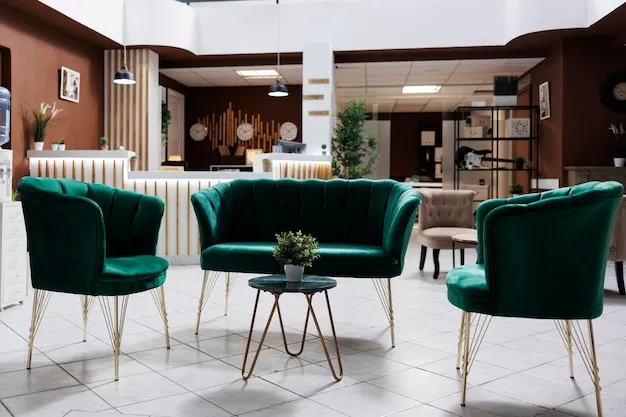
Ottomans see more direct skin and clothing contact than backed seating, so fabric choice carries real weight in the spec. The ACT abrasion guidance distinguishes textile types: its voluntary high-traffic guideline is 30,000 Wyzenbeek double rubs for woven or knit fabrics and 50,000 for coated fabrics. Those test results do not predict service life. Compare the exact vinyl or fabric against the zone's spills, foot contact, abrasion evidence, and approved care. Neither the material label nor a warmer appearance establishes superior durability. Our fabric durability checker displays voluntary abrasion guidelines by textile type and traffic. Compare the actual fabric's test report with the applicable guideline and its approved care instructions; the checker does not verify a submitted fabric rating.
Storage ottomans versus solid ottomans
If a storage lid is proposed, obtain separate hinge, lid-support, seating-load, and inspection documentation. Compare it with a solid model on the same use and care requirements; fewer moving parts do not by themselves establish a lower lifetime maintenance cost. The storage ottomans guide provides related questions, not a rating for the selected item.
Sizing and placement in a lounge
Use twelve to twenty inches only as an illustrative height-comparison band. Test the actual ottoman, compressed seating cushions, and intended footrest or seating use together; the band is not a standard height or a fit guarantee. Leave enough clearance around each ottoman for foot traffic and staff to move through during events, particularly in hotel lobbies where luggage carts and housekeeping traffic need a clear path. For a full lounge or lobby buildout, our commercial lounge seating guide covers how ottomans fit into a complete seating plan alongside sofas, armchairs, and side tables, and the ottomans category provides furniture concepts for comparing shapes and finishes; obtain exact dimensions and current options from the supplier.
If your project is specifically a hotel lobby, treat the ottoman group as part of the arrival experience rather than an isolated purchase. Our hotel lobby furniture guide covers how ottomans, sofas, and reception seating should relate to each other by scale and finish so the whole space reads as one designed environment instead of pieces that happen to share a floor. Guests notice consistency even when they can't name what's off about a mismatched lobby, and ottomans are usually the piece that gets added last and matched worst.
Ordering at volume
Confirm each ottoman's schedule separately from the sofas. A ten to fourteen week custom-order cycle can be used for a preliminary calendar, but current fabric approval, production, and freight dates must come from the supplier. If you're outfitting multiple properties or a large lobby with a consistent look, request a full-quantity proposal and written fabric and finish batch controls; one order alone does not guarantee matching across every piece. Use our furniture cost calculator to model a mixed lounge order with the selected optional delivery allowance before finalizing quantities; the modeled allowance is not a delivered quote.
Request a quote with the ottoman shapes, quantities, upholstery direction, and intended use as seating, footrests, or storage. Ask responding suppliers for the assembled seating and lid limits, hinge details, approved cleaning, and sample options for the proposed models.
Check storage lids and modular connections
On a storage ottoman, inspect the hinges, lid support, usable internal space, and cleaning access. Confirm the item is rated for the seating use you intend; a storage compartment alone does not establish its load rating.
For modular pieces, check how connectors hold the planned arrangement and how staff release them. Draw both the everyday layout and an alternate configuration, then identify a storage position for unused pieces. Assign responsibility for resetting and checking the modules.
Related reading
- Storage Ottomans Guide
- Modular Lobby Ottomans Guide
- Commercial Accent Armchairs Guide